
This game puzzle comes from GM Ian Rogers’ excellent book ‘Oops! I resigned one more time!’. It features a game from the 1985 Australian Open in Ballarat, between David Hacche and Eddy Levi.
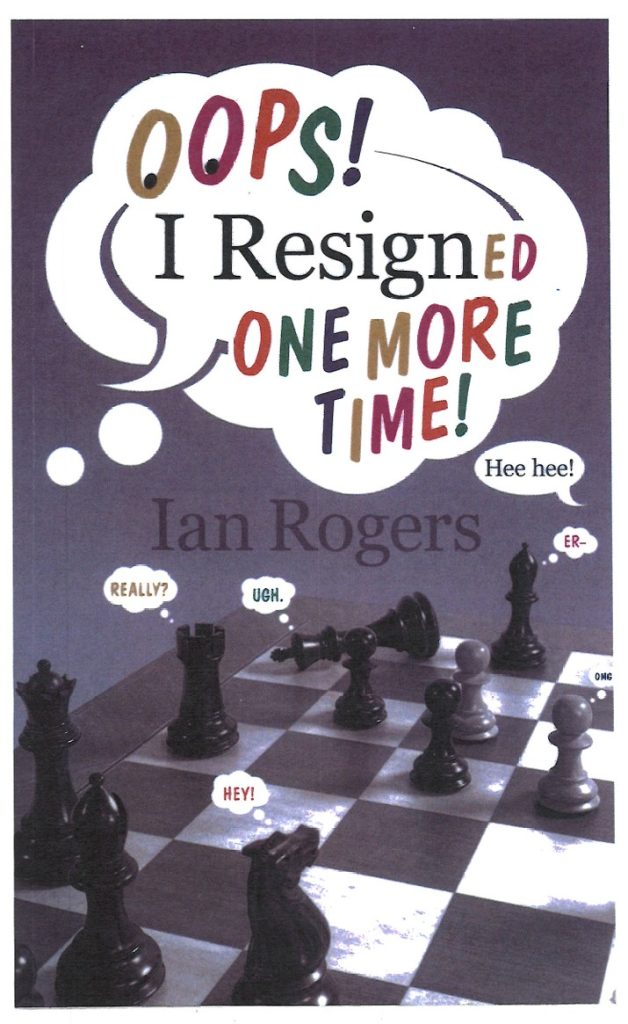
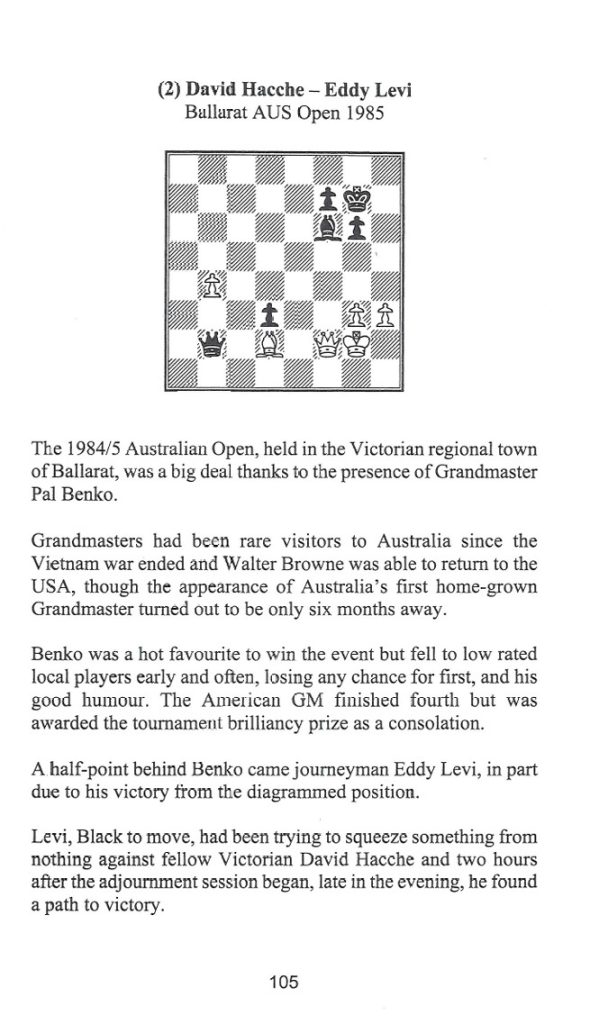
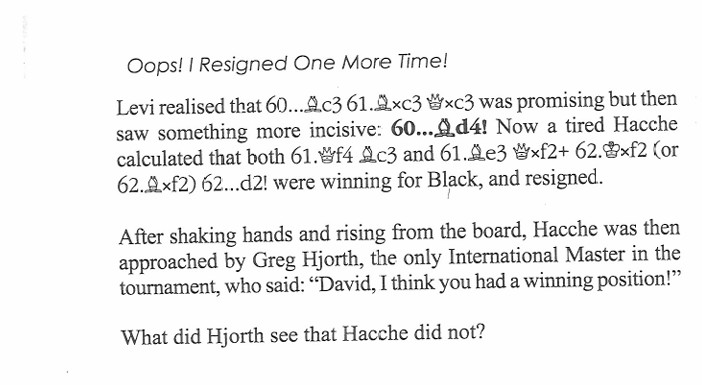
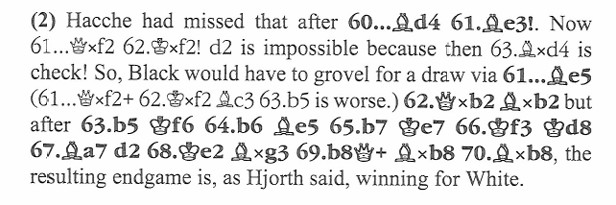
This game puzzle comes from GM Ian Rogers’ excellent book ‘Oops! I resigned one more time!’. It features a game from the 1985 Australian Open in Ballarat, between David Hacche and Eddy Levi.
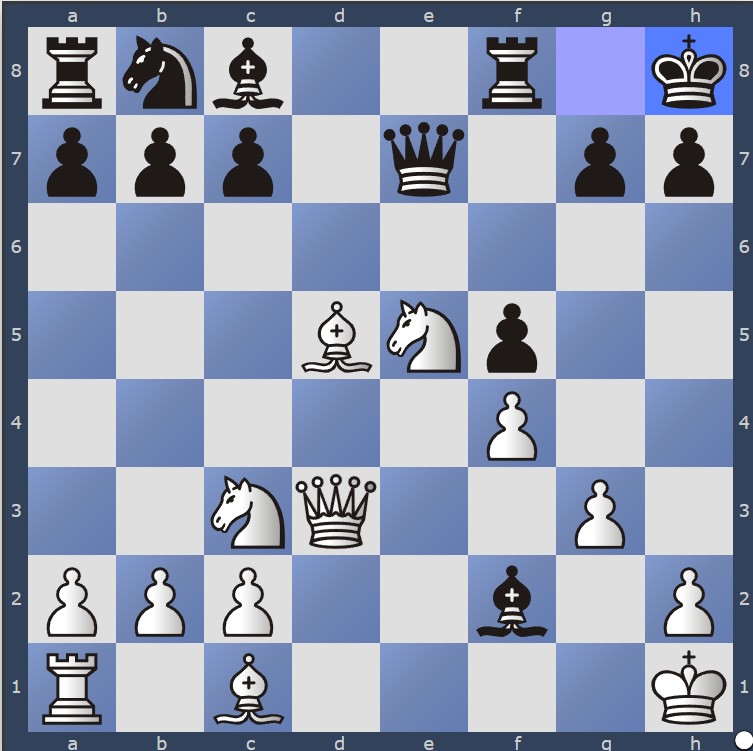
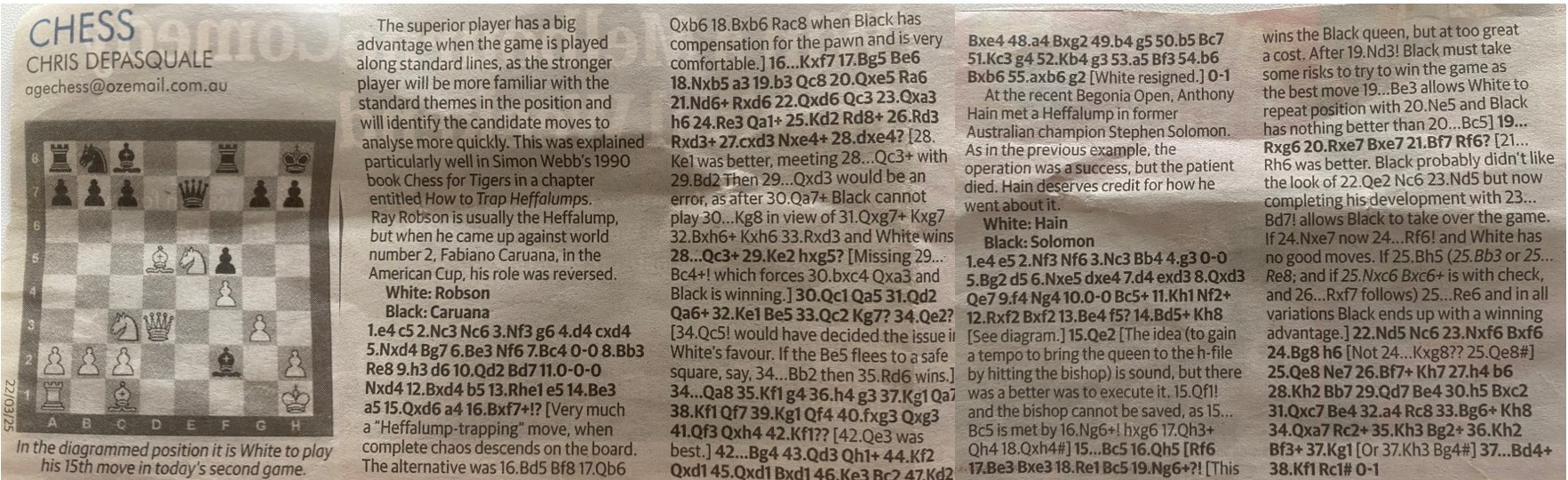
Chris writes in his column: “At the recent Begonia Open, Anthony Hain met a Heffalump in former Australian champion Stephen Solomon. As in the previous example (Robson vs Caruana, American Cup), the operation was a success but the patient died. Hain deserves credit for how he went about it.” Here is the game annotated by Chris – (see Diagram below labelled: “In the diagrammed position it is White to play his 15th move in today’s second game.”)
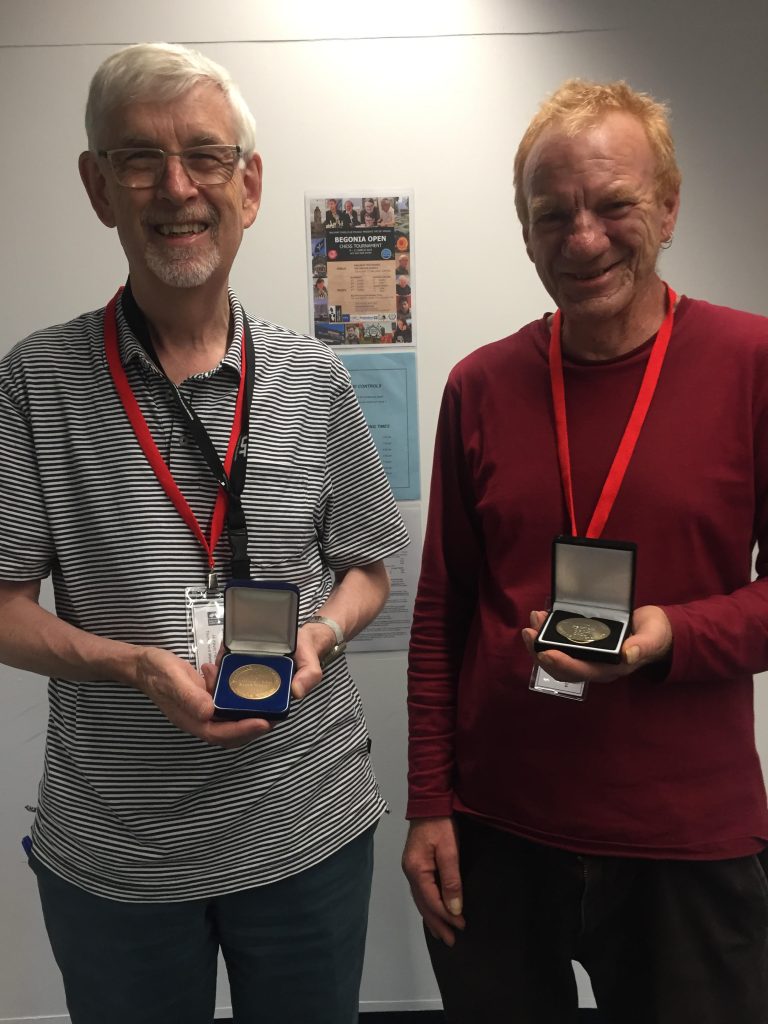
Ballarat Chess Club has not one but two holders of the Koshnitsky Medal for chess administration. This says a lot for our club: Many club organisers from around Australia are always keen to hear how Ballarat Chess Club has managed to create the environment for a flourishing chess club. Well, much of the answer lies in the people supporting the playing of Chess in our community, with participants from as young as 4 years old to veterans in their eighties enjoying and learning the game at the club. Both Kevin Perrin and Patrick Cook have devoted a significant portion of their lives to helping Ballarat Chess to grow to what it has become today, in 2025.
Report by Bas van Riel
The prestigious Koshnitsky Medal 2002, was awarded to Life Member of the Ballarat Chess Club Inc, Kevin Perrin, in recognition of his life-long services and contributions to chess administration on local, regional and international levels. The medal was given to him by Robert Jamieson, the ACF Vice President, at the concluding ceremony of the Australian Chess Championships in Melbourne on January 9th, 2002.
The citation expressed in the ACF Bulletin by Mr. Graeme Gardiner, President of the Australian Chess Association, was:
“The Koshnitsky Medal for chess administration will be awarded to Kevin Perrin. Kevin has been involved on the administration side of both the Ballarat Chess Club and the
Ballarat Begonia Open for some 35 years. His involvement in chess organisation extends to the Victorian Country Championships for many years. The citations were compelling.”
A summary of Kevin’s long list of chess achievements and involvements reads as follows:
1966: Kevin Perrin joined the Ballarat Chess Club for the first time when he was 18 years old and played his first Ballarat Club Championship. Since then, he played in every Club
Championship, culminating in 2025 with the celebration of his 50th consecutive Club Championship.
1967: Kevin became an office bearer of the Ballarat Chess Club for the first time (as deputy secretary) and remained an office-bearer ever since, with the exception of one year.
1967: Kevin became the assistant-DOP of the Ballarat Begonia Tournament.
1973: Kevin became the main arbiter and manager of the Ballarat Begonia tournament, and remained so until 2007 with the exception of 1987 (G Males officiated).
1981: Kevin initiated the School Chess competition for the Ballarat Region, and he remained the driving force of the organisation for well over 15 years.
1985: He was one of the main organisers and DOP of the Australian Open held in Ballarat in December 1984 going into January 1985.
1985: Kevin was awarded the title (possibly the first Australian t.b.c ) of International Arbiter by FIDE.
1986: Kevin was the arbiter of the Australian Open in Adelaide.
1987: Kevin was the arbiter of the Junior World Championships held in Adelaide.
1989: Kevin became a Life Member of the Ballarat Chess Club.
Kevin was the Club champion of Ballarat seven times between 1973 and 1989.
Kevin won the Country Victorian Chess Championships six times, the last time (jointly) in
Bendigo, 2001.
Kevin was one of the co-founders of the rejuvenated Ballarat Chess Club in 1965.
His achievements in chess administration are too numerous to mention.
One of the most lasting involvements undoubtedly was, and still is, the organisation and
direction of the traditional Ballarat Begonia Tournament now (2025) going into its 59th year. Over the years, this tournament has attracted all of Australia’s top players, in addition to a varying group of strong overseas (grand) masters. Kevin has also tried to make this tournament attractive for everyday chess enthusiasts of all ages, thus providing a strong stimulus for chess in general.
This aspect of his work is accentuated every year by his organising and participation as DOP of the Country Victorian Chess Championships over many years. Under his guidance and supervision, this tournament has developed into a well-enjoyed chess ‘get together’ for players from all over country Victoria.
Patrick Cook
At the Opening Ceremony of the 2023 Begonia Open Chess Tournament, ACF President Gary Wastell announced the award of the very prestigious Koshnitsky Medal to our then President, Patrick Cook. Chess Victoria President, IM Leonard Sandler, had the honour of presenting the medallion.
Patrick has been a member of the club for many years and was first made President of the club decades ago. Patrick has been involved in the running of every aspect of the club over many years. He literally holds the key to the club and opens up every week, first in to set up for the junior chess coaching, and often last to leave, although not so much in these last few years as he has stepped back from some duties due to health issues.
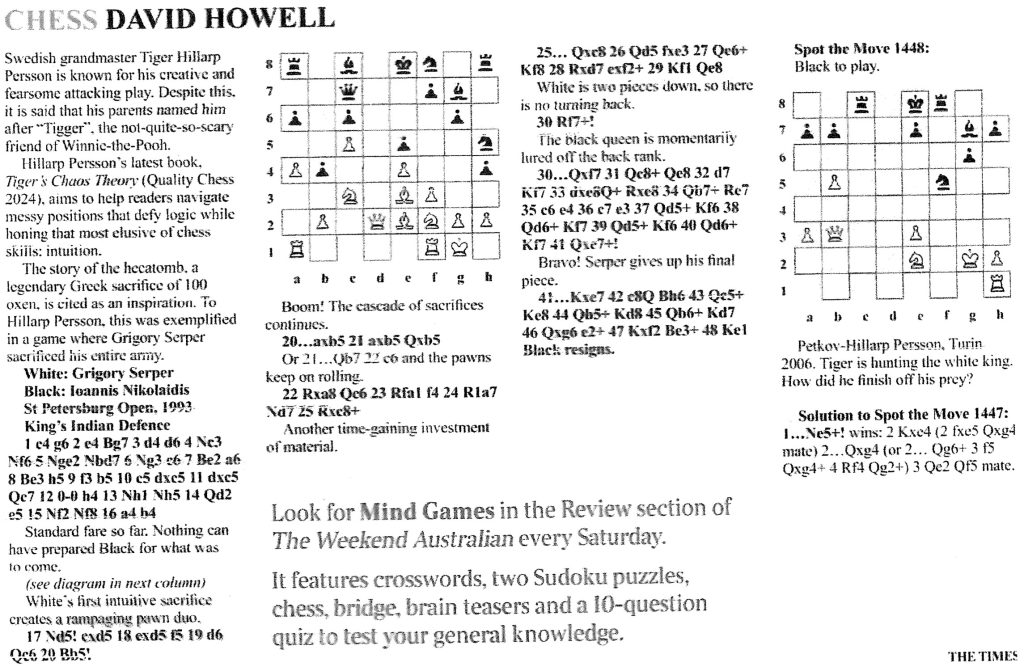
Kevin Perrin recently found this game, featured in David Howell’s The Times chess column, in his archives and played through it because he recognised the name ‘Grigory Serper’ as a player at the World Junior championship held in Adelaide in 1988 for which he was the chief arbiter. That event included household names such as Gelfand, Ivanchuk, Akopian, Adams, Polgar and many other future stars, but it was won by Joel Lautier from France. It was one of his most rewarding chess experiences.
Play through Serper, the usurper‘s game against Ioannis Nikolaidis to experience “the story of the hecatomb, the legendary Greek sacrifice of 100 oxen”, cited as an inspiration for Serper’s game. Swedish GM Tiger Hillarp in his recent book, “Tiger’s Chaos Theory” 2024, gives this game to show that intuition can play a vital part in chess; Serper sacrifices his entire army to win the game.
If you look closely , several familiar onlookers have been labelled on the Courier photo; do you recognise any of the others?
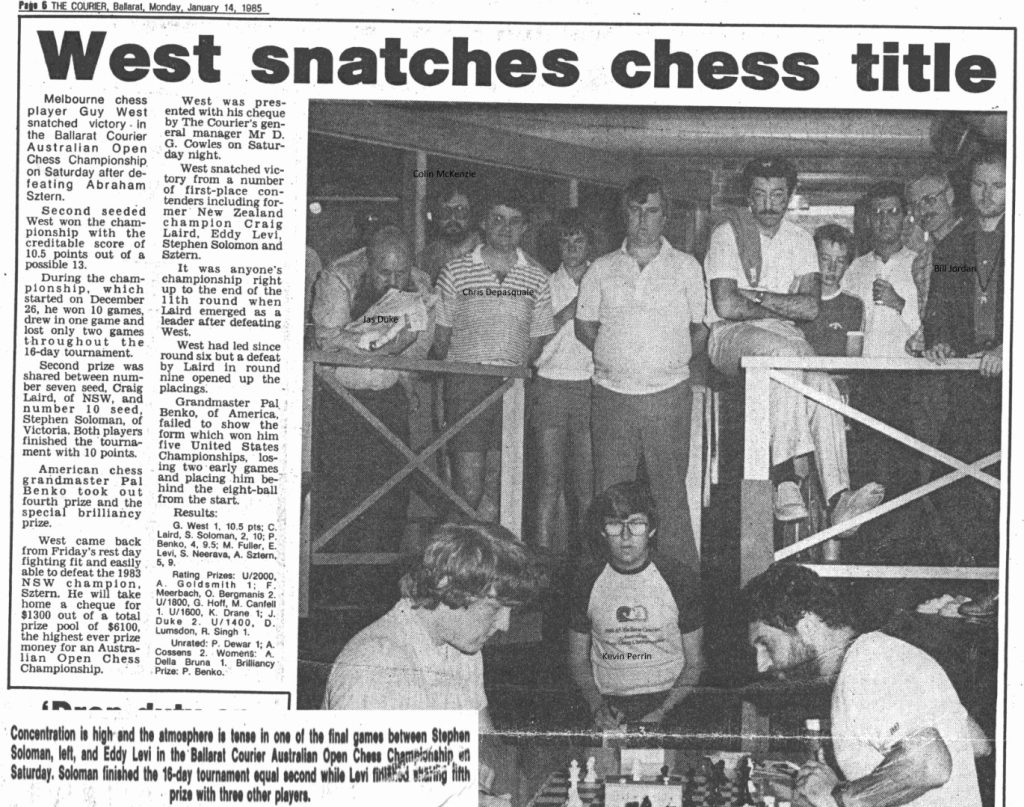
Here is the game between Stephen Solomon and Eddy Levi, pictured above.
You can see that Guy West is leading by half a point after Round 6. S Neerava, M Fuller, Chris Despasquale and C Laird follow on 5 points. you can see half of David Hacche on 4 points, on the left.
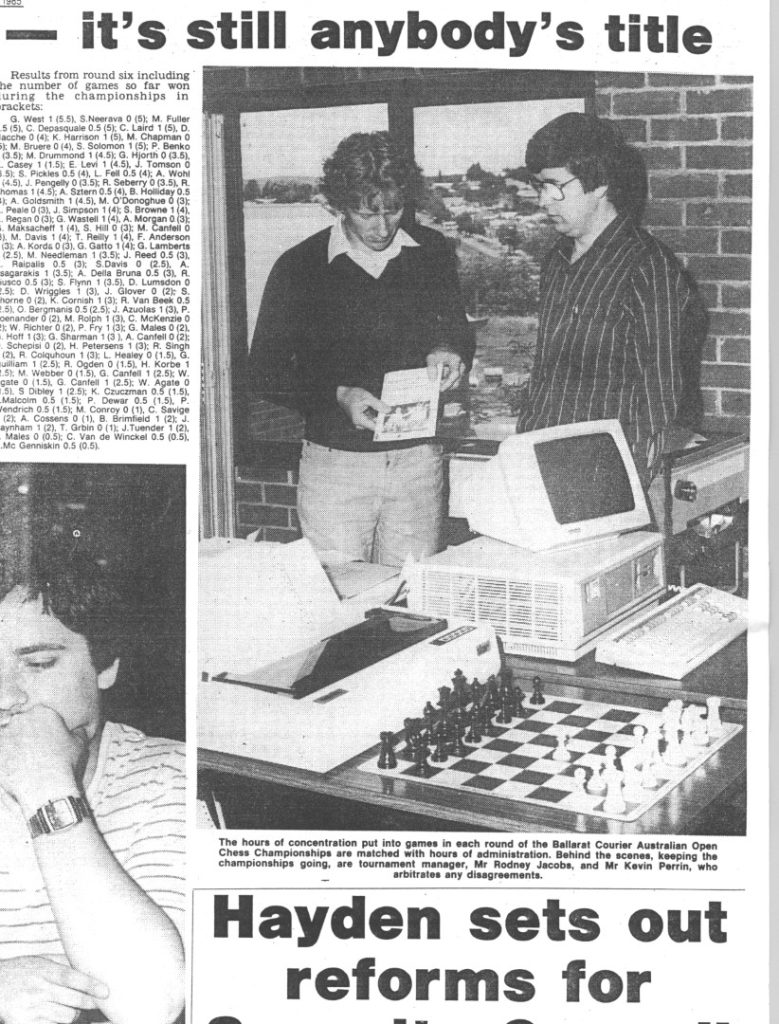
Here is a blistering Round 3 game between West and Hacche where White sacs a knight then offers a queen, with his bishop rook knight and pawn sufficient to complete the job, if the queen sac was taken.
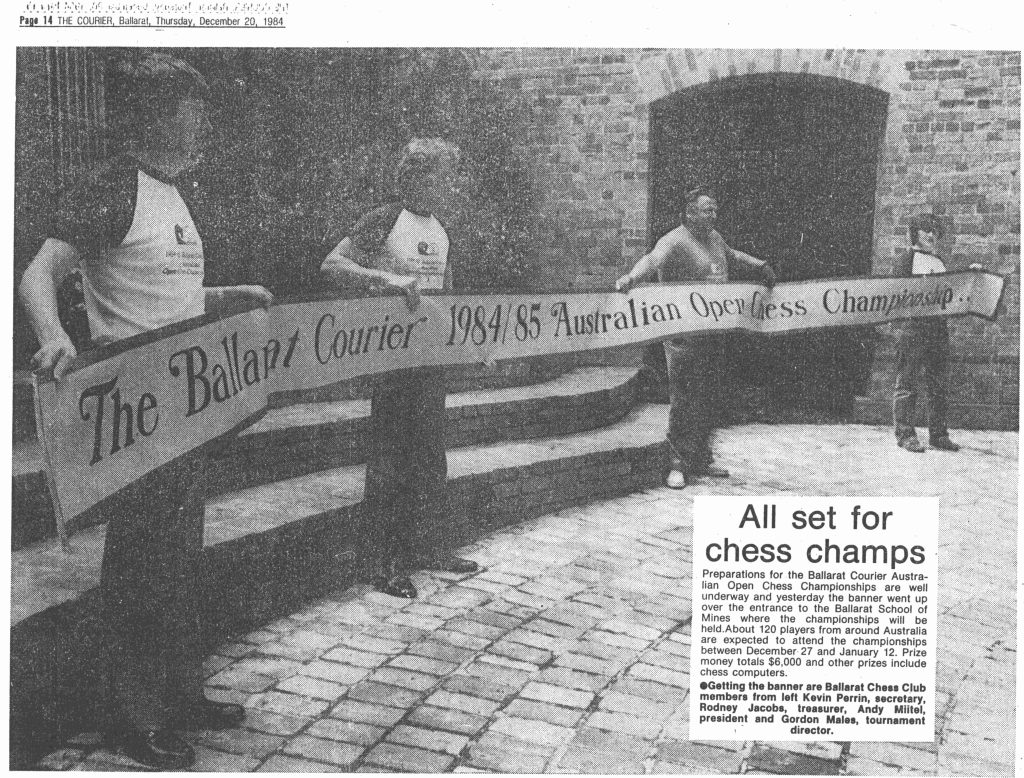
Although it is difficult to see their faces in this Courier article, the standard bearers were Kevin Perrin, Rod Jacobs, Andy Miitel, and Gordon Males, in their youth! Kevin and Rod are still active in the Ballarat Chess Club in 2025.
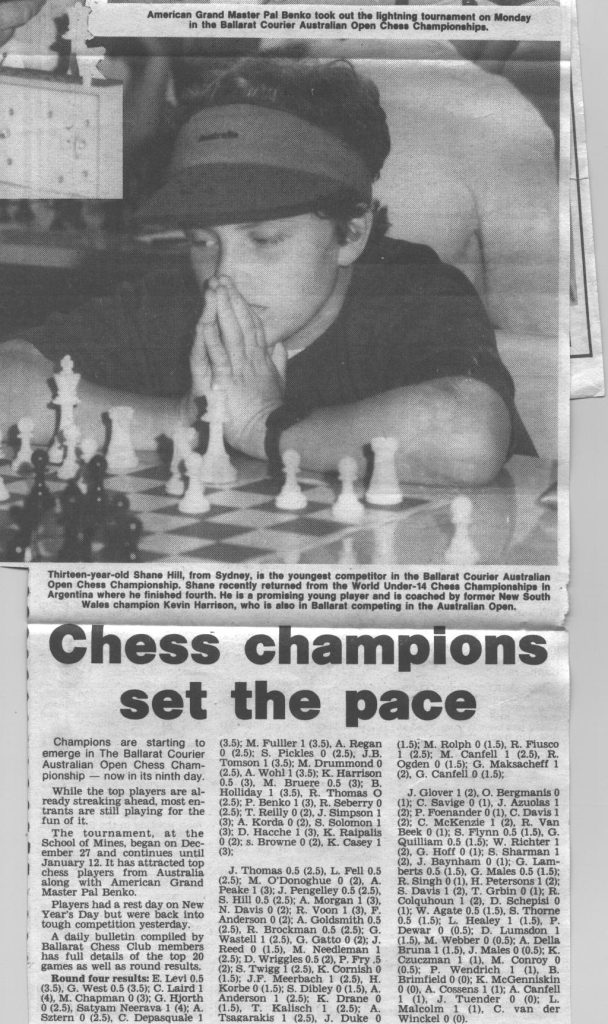
Shane Hill was the youngest competitor in the event, having just finished fourth in the World Under 14 Chess Championships in Argentina. This article was written after Round 4 was completed.
Kevin Casey comments on ChessChat:
The first Australian Open I ever played was in 1984/85, in Ballarat, VIC when I was in my late 20s. It was my introduction to serious chess in Australia. It was won by Guy West, who played very convincingly throughout and had a nice miniature (with queen sac) against Hacche. American GM Pal Benko was also there.
I remember starting surprisingly well, with wins in the first half of the tourney against IM Alex Wohl (a cheap tactical swindle/exchange sac saved my very dubious position), IM Greg Hjorth (the recent Commwealth champion, who opened with 1.Nc3), and Bruce Holliday, who was Queensland champion at the time, I believe). I then scored a convincing draw against GM Benko, playing the Veresov opening (he was cranky with the result, and later, he was even less happy when he lost to Holliday. He later blamed jet lag for his poor overall showing).
So after the first 6 rounds, I was right up there with the leaders. Alas, my good fortune and rampant tactical bamboozelments weren’t to last, as I was soon demolished by a then 19-year-old Stephen Solomon, an in-form Craig Laird and an always-dangerous Alan Goldsmith from South Australia – one of my favourite Aussie players and a tremendously dynamic attacker.
Little did I know that Solo would quickly develop into the most formidable player in Queensland chess history, Craig Laird would trade serious chess for prawn trawlers in the Gulf, and it would be 1999 before I played another Australia Open, in QLD. Good times….
Back in the day, before computers and printers were readily accessible to all, the Director of Play in any sizeable chess tournament faced the intense challenge of producing and keeping records for each participant on their own specific pairing card. The overall results were displayed on a blackboard, updated after every round. The individual results could be cross-checked by referring to the two player cards in question.

Top seed, GM Ian Rogers, drew with fourth seed, IM Stephen Solomon, in Round 4 and accumulated 6.5 points to reach an equal first position after Round 7.

So, the Director of Play’s job was not an easy task: The results in the 1984 Begonia had to be filled in for each of seven rounds, player card by player card (92 of them that year), before racing to the blackboard to write up the completed round’s results, manually working out the next round’s pairings and writing them up as well! It must have been a nightmare!

The added task for the sole DOP in 1984 (for comparison there were 6 arbiters at the 2025 Begonia Open!) was to supervise the numerous clocks and multiple time controls. The modern DGT clocks and new time controls make for an arbiter’s dream as no intervention is required at all. There were only the good old wind up BHB analogue clocks (like the Teters Tournament clock shown above), which had to be reset after each time control. The first control was always 40 moves in 90 minutes then generally followed by 20 moves in 20 minutes and then 10 minutes to finish the game. Some years then went to adjudication and that was fortunately a short-lived nightmare. Kevin Perrin reminisced: “I can recall running between the boards in the time scrambles to see which clocks were about to fall before they had to be reset. I also desperately tried to record the moves for the top few games in the case there was a dispute. Some players stored up there moves and tried to blitz their opponents as no recording was required in the final 5 minutes. There were no second arbiters so I did occasionally have to ask for some help on the distant lower boards. Oh, those were the days!”