The Founding / Charles Fisher Era 1856 -1880
About Charles Marshall Fisher

The Argus (Melbourne, Vic.) — Friday 2 May 1890
Charles Marshall Fisher (1845–Apr. 1890) was born in Creswick, and educated at Brighton. After leaving school he spent some time in Ballarat, where he acquired so great a reputation as a chess-player that he was chosen as a representative of Victoria in several inter-colonial matches with New South Wales. Fisher was president of the Ballarat Chess Club 1867–? and one of the Vice-Presidents of the newly formed Victorian Chess Association in Sept. 1877.
Later in life he resided for some years in Sydney, and was engaged there as a stock and sharebroker. He also occupied the position of chess editor of the Sydney Mail (1878–’79), and became known as a good player of blindfold chess.
In the year 1871 he returned to Melbourne, where he had a successful career as a sharebroker, and was understood to have realised a fortune in Broken Hill stock. He went to England about a year ago with his wife and daughters, and when last heard of he had gone to Nice, presumably in search of warm weather.
Mr C. M. Fisher succeeded the late John Wisker as chess editor of The Australasian (1884–’85), and occupied that position with great credit to himself for several years. As a chess editor he was always distinguished by his perfect fairness, by his uniform courtesy, by his mastery as a judge of the merits of problem composition, and by his skill as an annotator of games.
As a chess-player his most brilliant and most famous achievement was his defeat of Mr Louis Goldsmith at a time when that accomplished player was at the zenith of his chess strength.
The match, which was for the first five wins, partook of an inter-colonial character, being played during the years when Mr Fisher was a resident in Sydney. The score at one stage was in Mr Goldsmith’s favour by four wins to two wins, but Mr Fisher then showed his quality as a match-player by scoring the next three games in succession, thus winning the most interesting chess match that has yet been played in Australia.
After his return to Melbourne, he maintained his reputation as a match-player by twice carrying off the chief prize in handicap tourneys of the Melbourne Chess Club; Mr Burns, Mr Gossip, and other good players being among his competitors. As an odds-giver he was probably without a rival in Australia.
Of late years, however, his business engagements have been too engrossing to allow of his devoting much time to chess, and he has been content to be recognised in Melbourne chess circles as one who had won his spurs as a member of the “old brigade.” But it is known that during his holiday trip in Europe he had carried out the intention, of which he had often spoken to his Melbourne chess friends, of testing his quality as a player in some of the most famous of the chess resorts of Europe; and The Australasian of December 28 contains the score of a brilliant skirmish which he had won a few weeks previously at the Café de la Régence, in Paris. This is the last specimen of his chess skill which has been published in Melbourne.
Here is a brilliant blindfold victory by Fisher. Source: The Hull Packet and East Riding Times (Hull, England), Friday, September 9, 1881. Resize viewing board by dragging right side of board
Chapter One: The First Ballarat Chess Club (1856)
Editor’s Note — Bas van Riel: In response to an enquiry by Kevin Perrin to the Chess Librarian in charge of the M.V.Anderson Chess Library of the State Library of Victoria, a Mr.Ken Fraser responded with detailed information about the "Ballarat Chess Clubs (plural)"
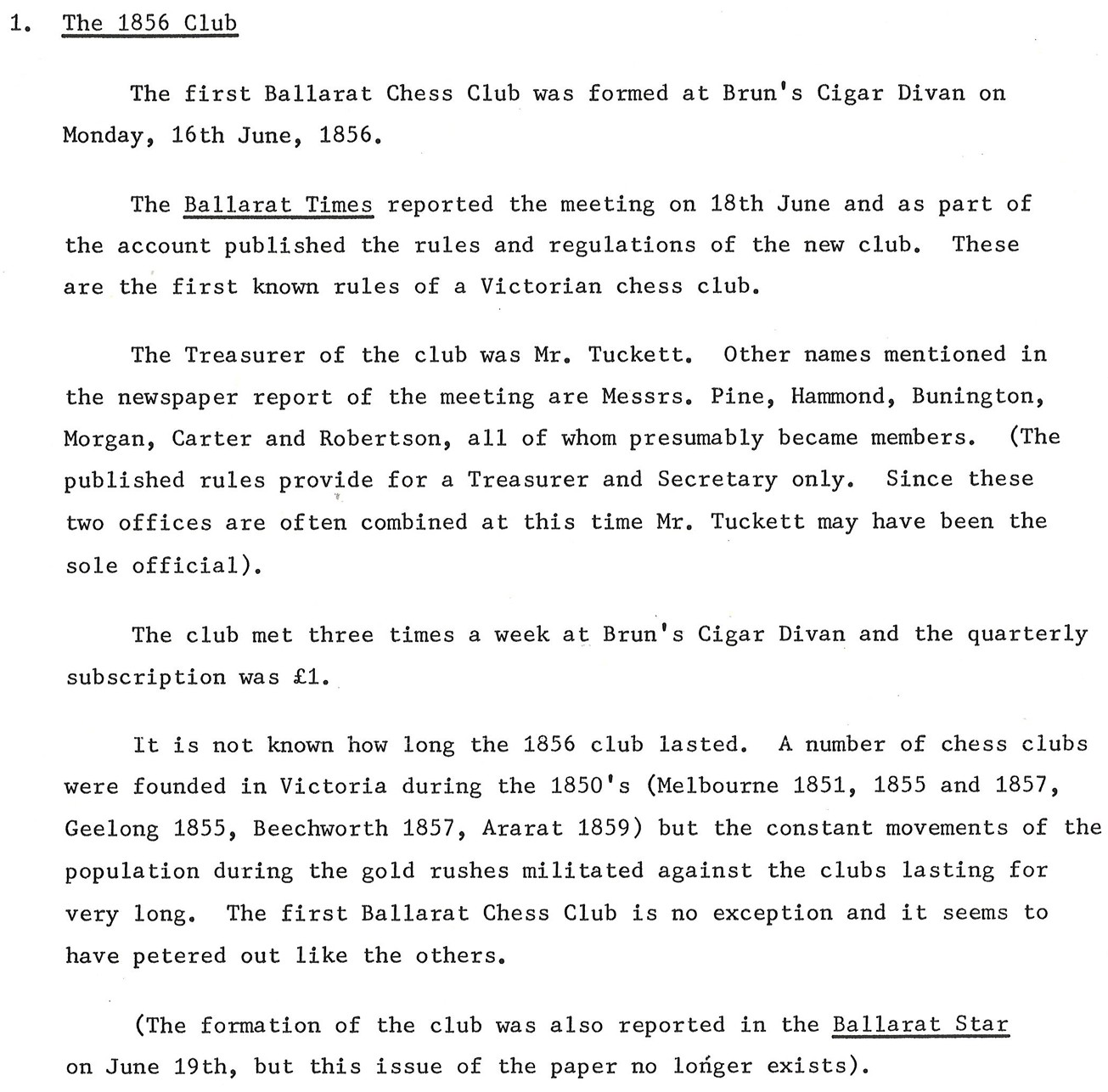
The first Ballarat Chess Club was formed at Henry J. Brun’s Cigar Divan on Monday, 16 June 1856. The Ballarat Times reported this meeting on 18 June and included the rules and regulations of the new club. These are, in fact, the first published rules of a Victorian chess club. The formation of the club was also reported in The Ballarat Star on 19 June 1856, but this issue of the paper no longer exists. The Treasurer of the new club was Mr. Tuckett. Other names mentioned in the newspaper report of the meeting are Messrs. Pine, Hammond, Bunington, Morgan, Carter and Robertson, all of whom presumably became members. The rules provided for a Treasurer and Secretary only, so Mr. Tuckett may have been the sole official. The club met three times a week at Brun’s Cigar Divan and the quarterly subscription was one pound.
It is unknown how long the 1856 club lasted. We have not been able to find any information about the people involved in the chess club, nor recovered any of their games, nor are we aware of any competition they may have taken part in during these very first years of a Ballarat Chess Club.
A number of chess clubs were founded in Victoria during the 1850s (Melbourne 1851, 1855 and 1857; Geelong 1855; Beechworth 1857; Ararat 1859), but the constant movement of the population during the gold rushes worked against these clubs lasting for very long. The first Ballarat Chess Club is no exception, and it seems to have petered out like the others.
The Cigar Divan was located in Main Road, with Mr. Henry Brun recorded as the owner of the shop. A Cigar Divan was a British invention — a mixture of a shop where cigars were sold, and a club or café‑style establishment where customers were offered a stimulating atmosphere to smoke their cigars, have a drink and socialise. In England, chess‑playing facilities were often provided by Cigar Divans in order to entice customers to stay longer, thereby spending more money.
The stretch between Eureka and York Street on Main Road was the centre of Ballarat in the very early days of the town, because it was close to the first alluvial gold discovery at Golden Point. However, the Ballarat Star (March 1857) reported that Henry Brun — described as a former tobacconist — had moved on, one year after the foundation of Ballarat’s first Chess Club, and that he had bought Brun’s Hotel, also in Main Road. He sold or leased his Cigar Divan to one Miss E. Marriott, and that is where the story of the first Chess Club stops, unfortunately.
To give an idea of how Ballarat looked at the time of the first Chess Club, the attached photograph shows Ballarat at the junction of Main Road, Sturt Street and Bridge Street in 1857. It also refers to Henry Brun, “our first landlord”, and his new hotel. To make the picture more complete, it would be nice to solve the puzzle of where exactly the original Cigar Divan — the first Ballarat Chess Club — had been located in 1856.
References: The Ballarat Times, 18 June 1856; The Ballarat Star, 19 June 1856.

Black and white photograph of the lower end of Sturt Street, 1857, showing the Congregational Church in the right‑hand corner. A typed caption has been pasted at the top of the print reading: “Lower end of Sturt St 1857. 1) Right corner Congregational Church now Gas Company; 2) No buildings on north side but path to Brun’s Hotel; 3) Scores of tents at Golden Point; 4) Humffray’s Bookshop, corner of Bridge Street.”

His next venture — Brun’s Hotel.
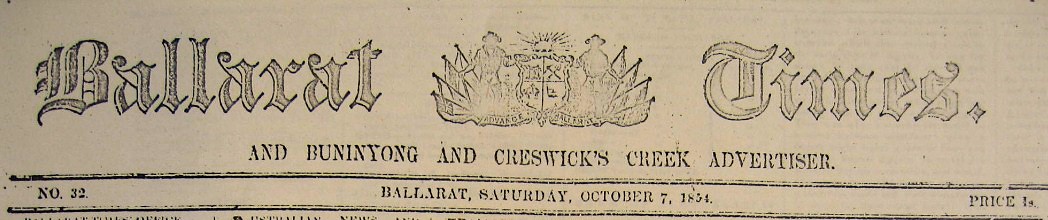
18 Jun 1856 — The inaugural Chess Club meeting at Brun's Cigar Divan, with Mr Tuckett in the chair.
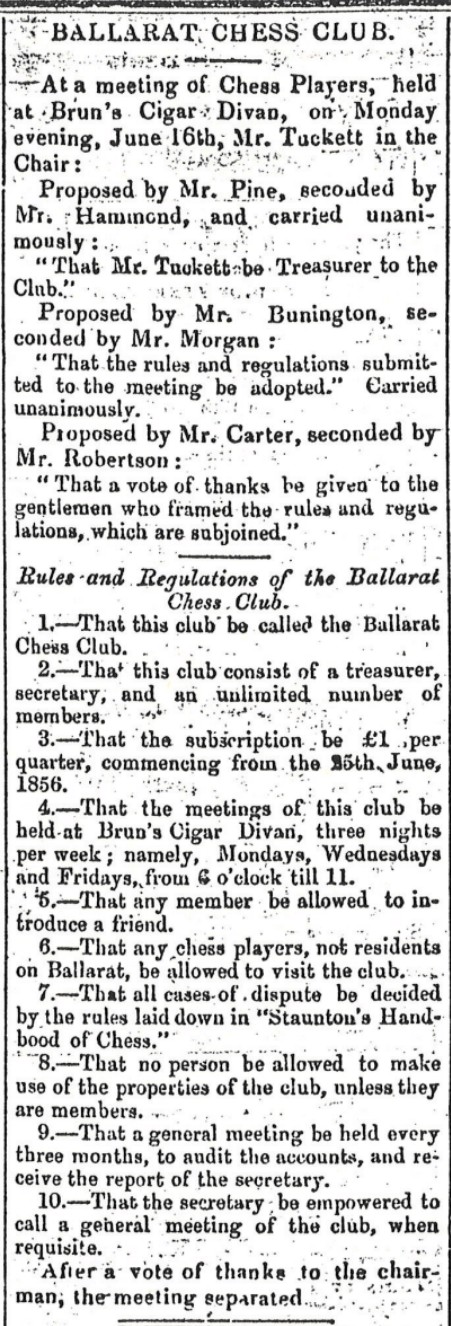
1856.06.18 Ballarat Times article here... open image
Ballarat Chess Club
At a meeting of Chess Players, held at Brun's Cigar Divan, on Monday evening, June 16th, Mr. Tuckett in the Chair:
Propesed by Mr. Pine, seconded by Mr. Hammond, and carried unanimously: "That Mr. Tuckett be the Treasurer to the Club."
Proposed by Mr. Bunington, seconded by Mr. Morgan: "That the rules and regulations submitted to the meeting be adopted." Carried unanimously.
Proposed by Mr. Carter, seconded by Mr. Robertson: "That a vote of thanks be given to the gentlemen who framed the rules and regulations, which are adjoined."
Rules and Regulations of the Ballarat Chess Club
1.- That this club be called the Ballarat Chess Club
2.- That this club consist of a treasurer, secretary and an unlimited number of members.
3.- That the subscription be £1 per quarter, commencing from the 25th June, 1856.
4.- That the meetings of this club be held at Brun's Cigar Divan, three nights per week; namely Mondays, Wednesdays and Fridays, from 6 o'clock to 11.
5.- That any member be allowed to introduce a friend.
6.- That any chess players, not residents on Ballarat, be allowed to visit the club.
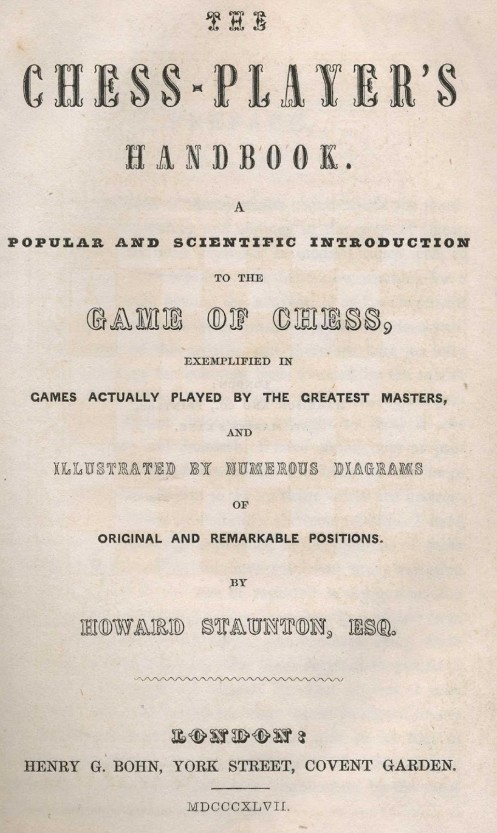
7.- That all cases of dispute be decided by the rules laid down in "Staunton's Handbook of Chess."
8.- That no person be allowed to make use of the properties of the club, unless they are members.
9.- That a general meeting be held every three months, to audit the accounts, and receive the report of the secretary.
10.- That the secretary be empowered to call a general meeting of the club, when requisite.
After a vote of thanks to the chairman, the meeting separated.
Staunton's Handbook of Chess - BCC Rule Book of the time.
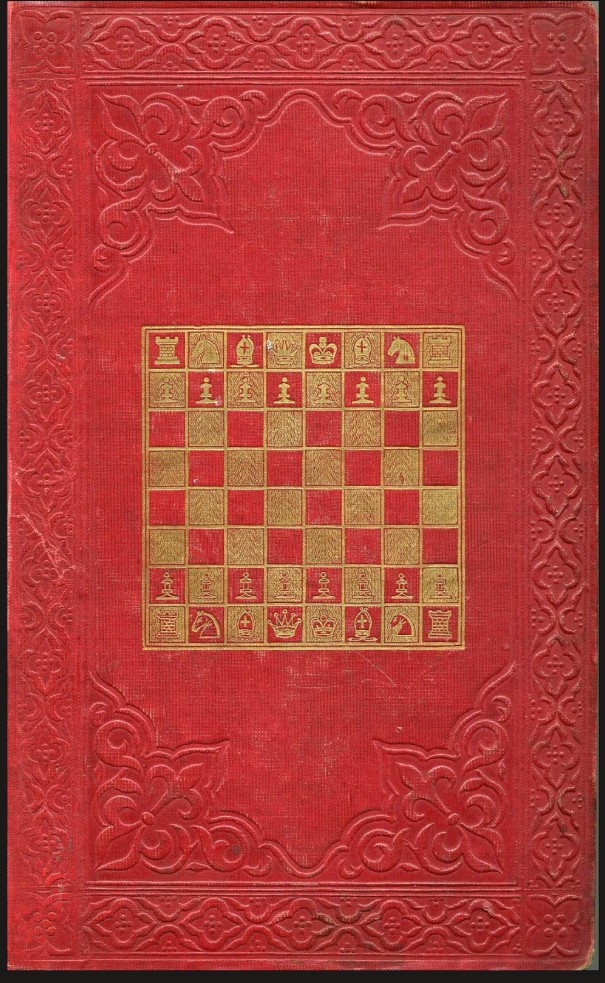
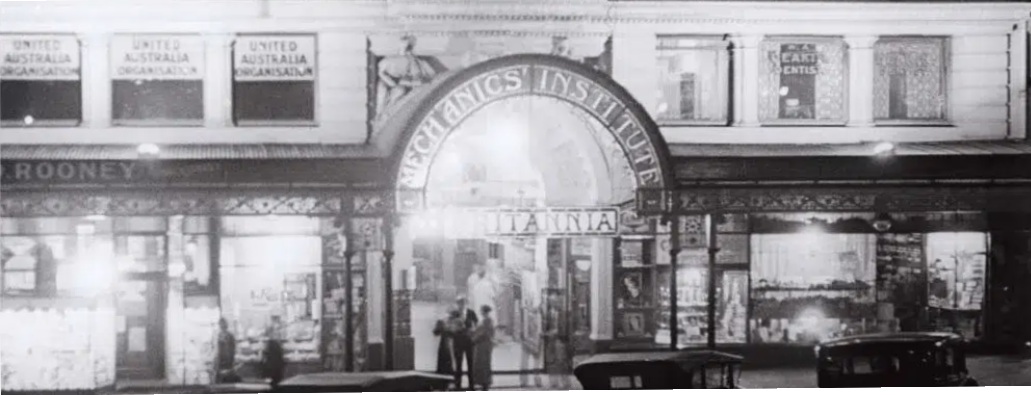
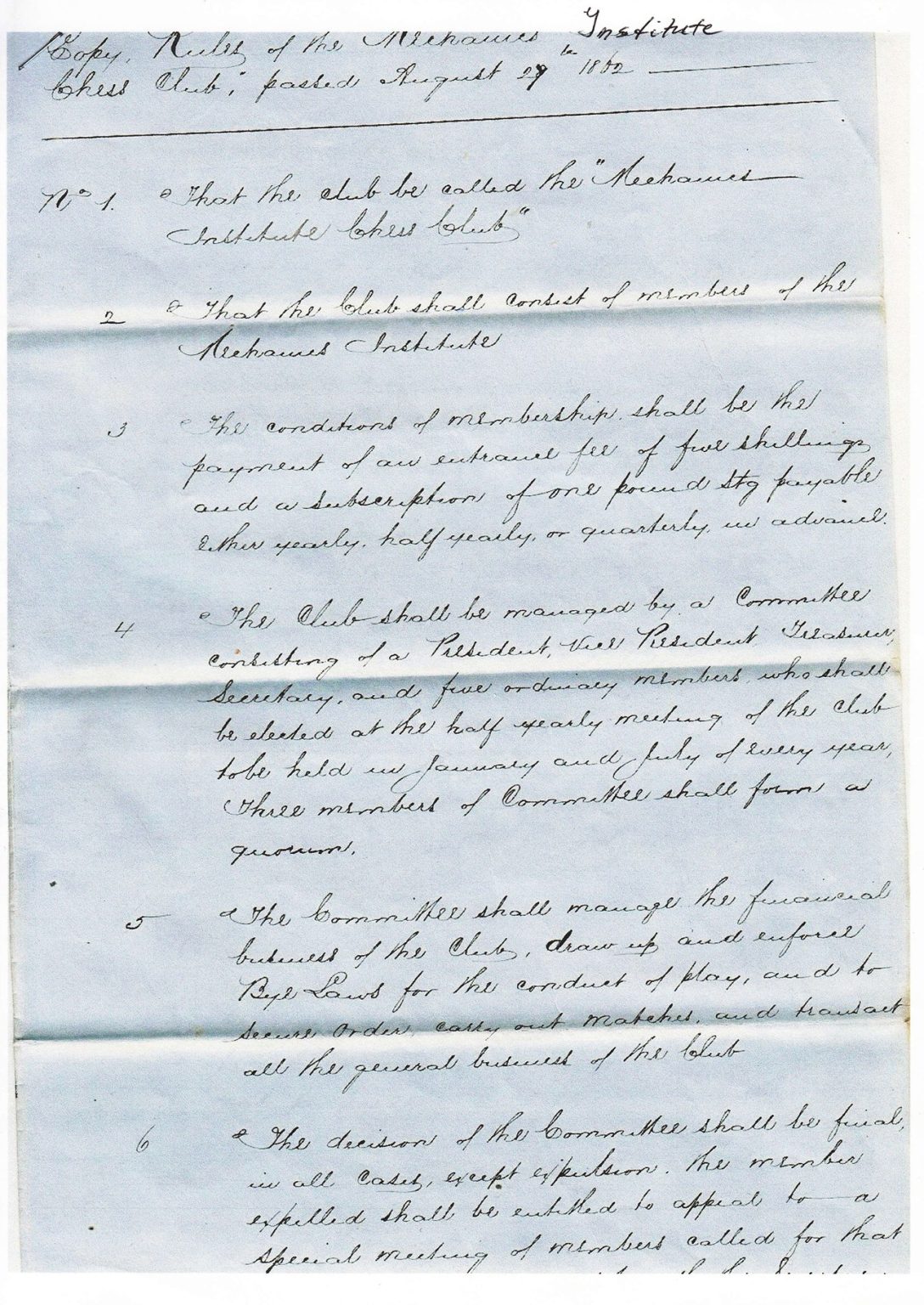
27 Aug 1862 — Copy of Club Rules
Chapter 2. The Establishment of the Ballarat Chess Club in 1865 at the Mechanics' Institute
The continuation of Ken Fraser's letter regarding the 1865 club.
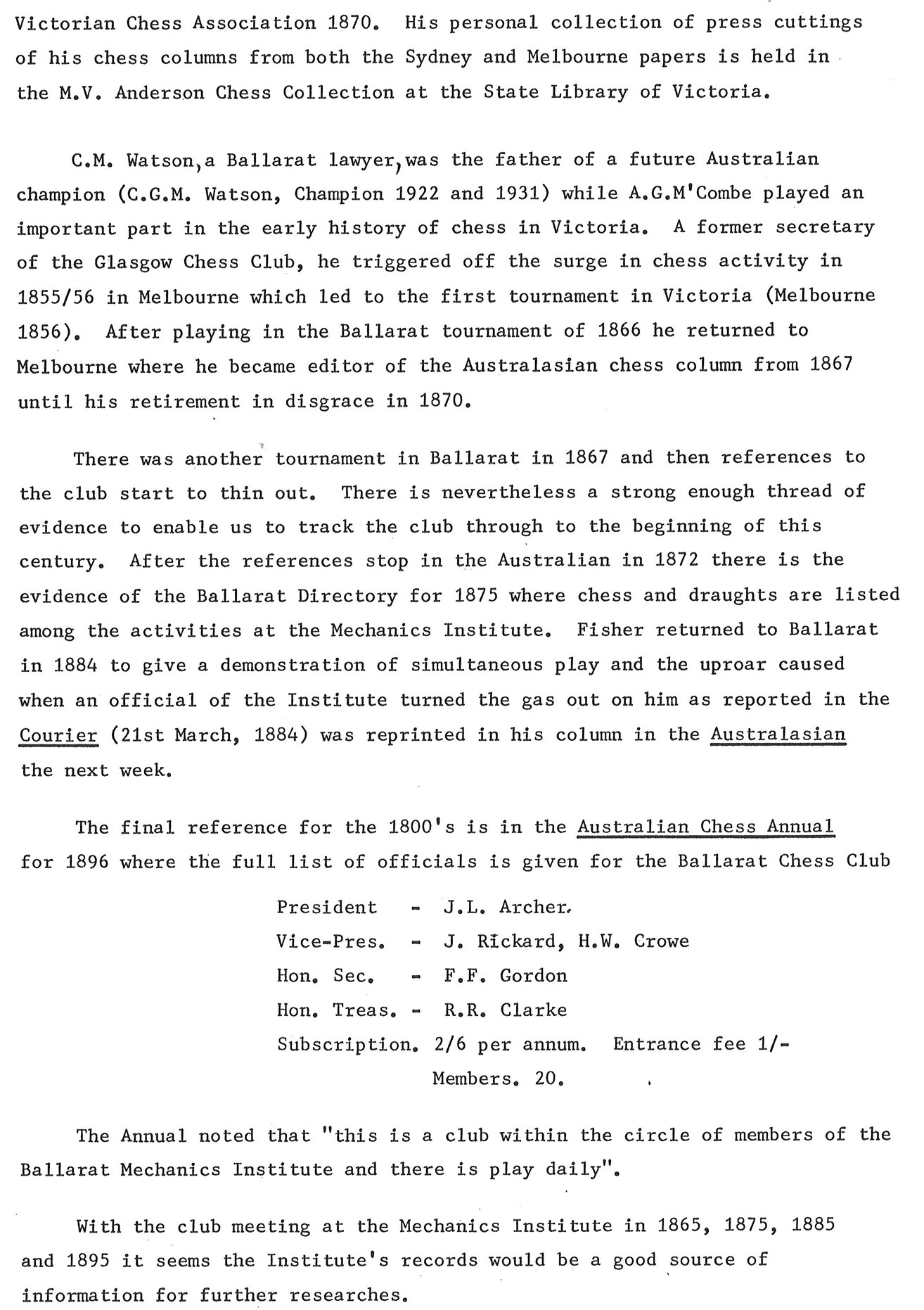
25 February 1865 — The Ballarat Star
A Chess Club
SIR, — It is a remarkable fact that although we have in Ballarat clubs and societies of almost every description, we do not possess, and (so far as I am aware) never have possessed a chess club. There are probably four or five hundred chess players in the town, many of whom would be delighted to have the opportunity of enjoying a quiet game; and there are doubtless many others who would gladly learn it, if facilities offered for their doing so.
With a view to test public feeling on the matter it is proposed to hold a meeting to discuss the subject, of which notice is given in your advertising columns. Trusting soon to commence (at the club) as I now end,
I am, sir,
24th February.
KINGS PAWN TWO MOVES.
1 March 1865 — The Ballarat Star
Formation of a Chess Club
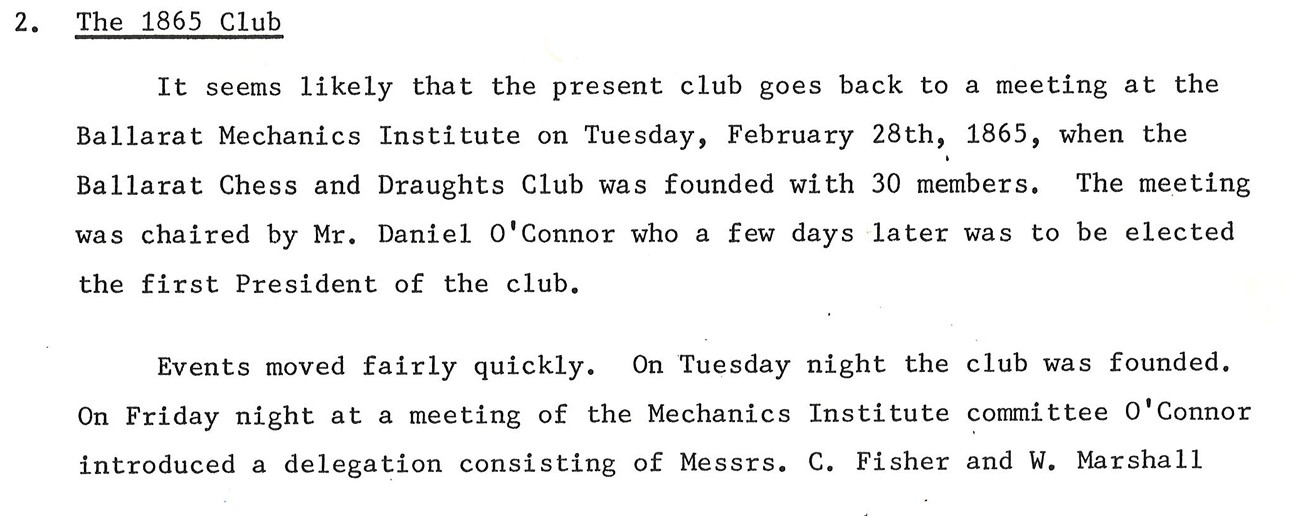
A meeting of gentlemen interested in the formation of a chess club was held on Tuesday evening in the Mechanics' Institute, Mr P. O'Connor in the chair. The formation of such a club was decided upon, and it was resolved that it should also embrace draught playing, and be called the Ballarat Chess and Draught Club.
A sub‑committee was formed for the purpose of drawing up rules and communicating with the committee of the Institute for the purpose of obtaining a room for the use of the members. The committee will bring up its report on Saturday evening, when a general meeting of the club will be held.
Thirty members are already enrolled.
7 March 1865 — The Ballarat Star
General Meeting of the Ballarat Chess and Draught Club
A general meeting of the Ballarat Chess and Draught Club was held on Saturday, when the rules, as prepared by the sub‑committee, were amended and adopted. Mr Daniel O'Conner was elected president, Dr Richardson vice‑president, and Mr C. Fisher honorary secretary and treasurer.
A committee was then chosen, consisting of Messrs Bolton, Kemp, Marshall, and Pennell. The club will meet every Thursday and Saturday, in one of the classrooms of the Mechanics' Institute, at 7.30 p.m.
The subscription for members of the Institute is to be 2s 6d per quarter, and non‑members 5s, with an entrance fee of 2s 6d. About 35 names have already been handed in.
10 March 1865 — The Ballarat Star
Meeting of the Ballarat Chess and Draught Club
The members of the Ballarat Chess and Draught Club met on Thursday evening, in the Hall of the Mechanics' Institute, and played a number of games. The club has already nearly forty members enrolled, and that number bids fair to be speedily increased.
14 February 1866 — The Ballarat Star
Ballarat Chess Tournament Concluded
The Ballarat chess tournament, the commencement of which we noticed some time ago, was concluded a few days ago, and resulted in favour of Mr Charles Fisher, who has succeeded in proving himself champion of the Ballarat Chess Club.
Since the conclusion of the tournament, Mr Fisher has played with a gentleman lately, we believe, from Geelong, who, according to his own account, had beaten all the chess players in that lively town. The Geelong player evidently considering that Ballarat could not furnish an antagonist worthy of his steel, never joined the local chess club, and, we understand, that he would not even condescend to compete with our inferior players — as he appeared to consider them — unless there was some stake on the game.
Accordingly, Mr Fisher, departing from his usual rule of not playing for money, accepted the challenge of the Geelong champion to play him the best five of nine games for £3 a side. The match was, of course, regarded with a considerable amount of interest by the members of the club, and it resulted in the utter discomfiture of the Geelong representative, who by the way is now a resident of Ballarat.
Mr Fisher won the first five games running, thus teaching his opponent a lesson to respect a little more the talent to be found in the Ballarat Chess Club.
23 February 1866 — The Ballarat Star
Annual Meeting of the Ballarat Chess Club
At the annual meeting of the Ballarat Chess Club, held last night in the Mechanics' Institute, Mr D. O'Connor in the chair, the annual report was read, showing the club to be in a very prosperous condition.
A letter from the secretary of the Melbourne Tournament Committee was read, inviting the members of the club to take part in the ensuing tournament, to be held next month in Melbourne. It was resolved to reply, expressing the regret of members at their being unable to accept the invitation owing to their inability to devote the necessary time.
Various alterations were made in the rules. The following gentlemen were elected for the year, viz.: Mr D. O'Connor, president; Mr C. Fisher, vice‑president; Mr J. M. Connell, secretary and treasurer; and Messrs R. Mitchell, J. Harvey, C. Watson, and T. Gaggin, members of committee.
2 April 1866 — The Argus
Visit of Mr Fisher to the Melbourne Chess Tournament
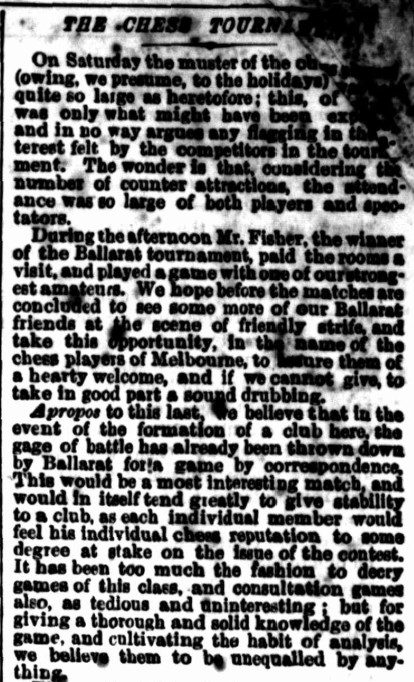
During the afternoon Mr Fisher, the winner of the Ballarat tournament, paid the rooms of the Melbourne Chess Tournament a visit, and played a game with one of our strongest amateurs. We hope before the matches are concluded to see some more of our Ballarat friends at the scene of friendly strife, and take this opportunity, in the name of the chess players of Melbourne, to assure them of a hearty welcome, and if we cannot give, to take in good part a sound drubbing.
Apropos to this last, I believe that in the event of the formation of a club here, the gage of battle has already been thrown down by Ballarat for a game by correspondence.
This would be a most interesting match, and would in itself tend greatly to give stability to a club, as each individual member would feel his individual chess reputation to some degree at stake on the issue of the contest.
It has been too much the fashion to decry games of this class, and consultation games also, as tedious and uninteresting; but for giving a thorough and solid knowledge of the game, and cultivating the habit of analysis, we believe them to be unequalled by anything.
Chapter 3 Ballarat Handicap Chess Tournament: Sept.1866 - Apr.1867 newspaper reports
Editor’s Note — BvR:
As far as I know, this is one of the first chess tournaments held in Australia, albeit restricted to players from Ballarat. It probably was the longest ever played, lasting over a period of no less than eight months (i.e. September 1866 – April 1867), and ending in beautifully reported controversy.
Amongst the players was the winner, Charles M. Fisher, one of the strongest players in the colony of Victoria. A database of 47 of his games can be found on the internet: https://www.chessgames.com/perl/chessplayer?pid=126904. They are amongst the oldest recorded games of Australia.
The old newspaper reports offer a clear and sometimes detailed picture of the chess activity in Ballarat more than 150 years ago.
Bas van Riel
8 September 1866 — The Ballarat Star
Ballarat Chess Tournament Committee Meeting
A meeting of the Ballarat chess tournament committee was held last evening at the Mechanics’ Institute, when the players entered were handicapped and paired off by lot. There are still two more entries required, and as these will be forthcoming to‑day, we shall be enabled in our Monday’s issue to give the complete list of the players. The tournament will commence on Tuesday evening.
15 September 1866 — The Ballarat Star
Ballarat Chess Tournament Arrangements Finalised
The chess tournament has at length been finally arranged, under the most favourable auspices, and it has been decided by the committee that play shall commence on the evening of Tuesday, 11th September, at the Mechanics’ Institute. Fourteen days will be allowed for the first set of matches to be played off, and it is hoped members will not exceed that time, as by doing so the tournament will be protracted and the other competitors will be delayed from commencing the second series of matches.
It has been arranged for the winners in the first set to play for the first, second and third prizes. The committee, with the view of equalizing the play, has taken great pains to discover the relative strength of the respective players, so that neither should have any undue advantage, and has accordingly divided them into four classes — the first class giving the second a pawn and move, the third a pawn and two moves, and the fourth class a knight.
The following is the list of entries, together with their classification:
First Class — Messrs J. M. Connell, C. Fisher, and A. G. M’Combe.
Second Class — Messrs W. H. Batten, R. Bristow, H. Deveril, T. W. Gaggin, J. A. Harvey, W. Hogarth, R. S. Mitchell, A. Mongredien, D. O’Connor, J. B. Partridge, F. W. Tatham, and C. M. Watson.
Third Class — Messrs Davey, Kennedy, H. M. Pascoe, and J. Taylor.
Fourth Class — Messrs J. Campbell, J. P. Fennings, G. Fisher, J. Holdes, and J. A. Wilson.
The players have been paired as follows by lot:
Batten–Holdes 0–1
Bristow–Gaggin
Campbell–M’Combe
Connell–Taylor 1–0
Davey–Partridge 1–0
Deveril–O’Connor 1–0
Fennings–Hogarth
C. Fisher–Pascoe
G. Fisher–Harvey 0–1
Kennedy–Mitchell
Mongredien–Tatham 0.5–0.5
Watson–Wilson 0.5–0.5
25 September 1866 — The Ballarat Star
O’Connor vs Deveril — Tournament Game
The chess tournament, since its commencement, has progressed favourably, and the chess‑room is almost every evening crowded with players. Already no less than nine games have been played off, and more would probably have been concluded were it not that many of the competitors refrain from playing to the last moment, in order to make themselves proficient in the openings.
We give in detail the game played by Messrs O’Connor (white) and Deveril (black):
Editor’s Note — BvR: The comments in the game about some moves were actually made by the original reporter in 1866.
Resize viewing board by dragging right side of board
10 October 1866 — The Ballarat Star
The Ballarat Chess Tournament.
The tournament has advanced another stage, and the winners are now placed against each other. The losers are also matched to play for the smaller prizes. The chess room was enlivened since our last report by a visit from the second‑prize taker in the Melbourne tournament, and in a game which he had with one of our strongest players here he was worsted, but he pleaded as his excuse his want of practice for some months past.
A chess match with Melbourne by correspondence has been spoken of, and it is probable that a series of games between the two clubs will shortly take place.
Pairs among the winners who now play for the 1st, 2nd, and 3rd prizes:
Mr Davey v Mr Watson,
Mr Deverill v Mr Connell,
Mr Fisher v Mr Harvey,
Mr Gaggin v Mr M’Combe,
Mr Hogarth v Mr Mitchell,
Mr Holdes v Mr Mongredien.
Pairs among the losers in the first contest who play for the 4th and 5th prizes:
Mr Batten v Mr Fennings,
Mr Bristow v Mr Taylor,
Mr Campbell v Mr Kennedy,
Mr G. Fisher v Mr Pascoe,
Mr Tatham v Mr Wilson,
Mr O’Connor v Mr Partridge.
9 November 1866 — The Ballarat Star
The Ballarat Chess Tournament
The chess tournament is now drawing towards its close, and since our last report a very large number of games have been played. Only four players are now remaining — Messrs Fisher, M’Combe, Mitchell, and Watson. It is generally thought that the honor of first place will fall to the first‑mentioned player, who has not yet lost a game in the tourney; but Mr M’Combe brings with him a home reputation of no mean order, and Mr Watson, with the odds of pawn and move he receives, will stand a fair chance.
The winners of the pairs previously given were Messrs Watson, Deverill, Fisher, M’Combe, Mitchell, and Mongredien, who were again divided, the result of their play being as follows:
Mr Deverill v Mr Fisher 0–2;
Mr Mitchell v Mr M’Combe;
Mr Mongredien v Mr Watson 0–2.
The games among those who lost in the first matches have resulted in leaving six players, the winners among whom will come for the 4th and 5th prizes. In the pairs previously mentioned in a report in the Star for these prizes, the winners are Messrs Batten, Taylor, Kennedy, G. Fisher, Tatham, and O’Connor, who have been again divided by matching:
Mr Batten v Mr Taylor,
Mr Kennedy v Mr Tatham,
Mr G. Fisher v Mr O’Connor —
but none of these opponents have as yet played off.
24 April 1867 — The Ballarat Star
The Ballarat Chess Tournament
The Ballarat Chess Tournament has at length been concluded, resulting in the first prize falling to Mr C. Fisher, second prize to Mr C. M. Watson, third prize to Mr A. M. McCombe, fourth prize to Mr C. Q. Kennedy, and fifth prize to Mr W. H. Batten. The tournament has, on the whole, been a very successful affair.
A meeting was held on Wednesday last for the presentation of prizes. The first consists of a very handsome set of Staunton’s ivory chess men, in a carved ebony box, with handsome board, value ten pounds. The second prize is five volumes of Wright’s Encyclopedia, handsomely bound, value seven pounds. The remaining prizes are mostly books.
Subsequent published reports about the Ballarat Handicap Chess Tournament controversy
May 1867 — The Australasian
Subsequent published reports about the Ballarat Handicap Chess Tournament controversy
The Chess Tournament organised by the above club has, we are informed, been brought to an unsatisfactory termination, and the contests decided in a somewhat arbitrary manner, inasmuch as the degree of Champion has been conferred upon a competitor before the stipulated number of games has been played, and the second place given to another who had previously become, through defeat, ineligible to compete for that honour.
We glean from the correspondence before us that the competitor referred to first adopted the extremely slow‑movement tactics of play, consuming repeatedly half an hour, and in one instance an hour and a half, over a single move, and by this process prolonged one game over two evenings, and another game over three evenings, occupying about six hours each sitting; that after losing the second game he refused to proceed with the match until he had had an opportunity of studying the “irregular” openings and defences adopted by his opponent; and that after a lapse of several weeks he announced his readiness to continue the match, but at a time when it was impossible for his opponent to play, and through this default was declared the victor.
Whilst there is no law by which the time of moving can be limited, it is a well‑known fact that from four to six hours is the average time required to contest a well‑played game; and having examined carefully the games above referred to, we confess our inability to discover any intricate positions in the play of either combatant to warrant the unusually long time spent over these games. We also consider that the refusal of a player to proceed with a match until he had acquired a knowledge of the particular style of play adopted by his opponent is an innovation of the laws and chivalry of chess, and should disqualify the player from further contest with that opponent.
11 May 1867 — The Australasian
Subsequent published reports about the Ballarat Handicap Chess Tournament controversy
The remarks which we were called upon to make in our last issue with reference to this tournament have produced an angry protest from Ballarat, and we regret that the intemperate language used by the writer thereof, and the introduction of the name of a third person, preclude the publication of that communication in our columns.
Our statement, however, that the championship has been conferred upon a competitor before the stipulated number of games had been played is substantially admitted, whilst a general contradiction is given to the other portions of the report.
Our remarks about slow play were founded on what we believe to be reliable information, corroborated by the receipt of the two games which occupied five sittings, in one of which games it was shown that a whole evening was consumed over moves Nos. 19–26, and this we decidedly call slow play.
With reference to the statement that a player refused to proceed with the match until he had had an opportunity of studying the “irregular” openings and defences adopted by his opponent, we have the positive assurance of one of the players that such is the fact, and that an interval of nearly four weeks elapsed between the second and third games, namely, from about the 19th December to the 12th January.
A correspondent also furnishes us with the following particulars of the mode adopted in pairing the players in the fourth and last rounds, and which completely corroborates our statement that the “second place had been given to a player who had previously become, through defeat, ineligible to compete for that honour.”
Our correspondent states: “In the fourth round the competitors were reduced to three, say A, B, and C. These names were written on cards, and with a blank card were placed in a hat, and drawn out in the presence of the secretary in pairs. A and the blank were drawn together, and according to the rules which govern chess tournaments, A became a winner in that round. B and C were necessarily drawn together, and B became a winner also in that round. In the fifth and last round (and which always terminates a chess tournament) there were only two players left, A and B, none others being qualified to compete for first and second prizes. Therefore, if a second prize has been awarded it is an injustice to either A or B.”
We are also referred to the latest similar case on record in the Chess Players Magazine of November last, where, in a tournament between the members of the Birmingham Chess Club, the above mode of pairing odd numbers was adopted, and where the players paired with blanks were declared winners in which blanks were drawn.
Before quitting this subject we would, in the interest of chess, suggest the desirability of the gentlemen interested in the first and second prizes finishing the match by correspondence or by the medium of the telegraph, and would be glad to facilitate the arrangement of preliminaries if both players were agreeable to play in the way suggested.
Editor’s Note — BvR:
The above controversy seems to implicate the two top finishers of the tournament, Fisher and Watson, in a serious way. I find it hard to believe that they were involved, in light of the many subsequent reports which speak highly of their distinguished careers in chess, as well as in their professions. Both men apparently were highly regarded by their peers.
However, it is highly likely that the ‘controversy’ was actually unrelated to the Handicap Tournament, but rather to the tournament played early 1867 in Smythesdale, and won by Mr T. Taylor.
Chapter 4. Challenge by Mr. Andrew Burns for a match against Charles Fisher.
26 April 1869 — The Ballarat Star
Challenge by Mr Andrew Burns for a match against Charles Fisher
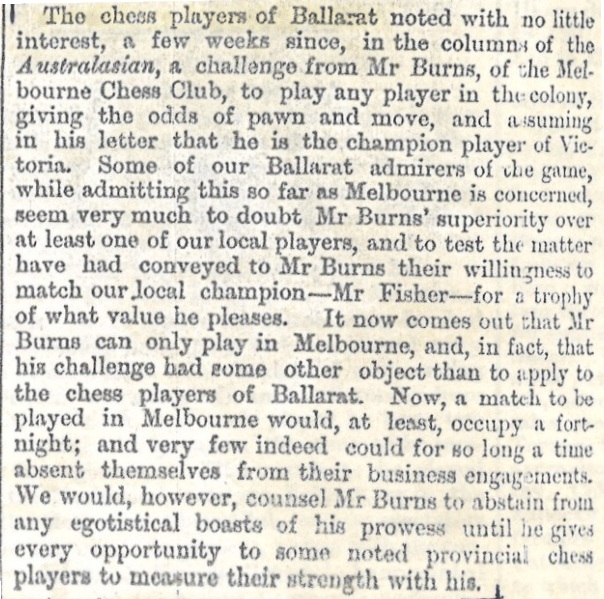
The chess players of Ballarat noted with no little interest, a few weeks since, in the columns of the Australasian, a challenge from Mr Andrew Burns, of the Melbourne Chess Club, to play any player in the colony, giving the odds of pawn and move, and assuming in his letter that he is the champion player of Victoria.
Some of our Ballarat admirers of the game, while admitting this so far as Melbourne is concerned, seem very much to doubt Mr Burns’ superiority over at least one of our local players, and to test the matter have had conveyed to Mr Burns their willingness to match our local champion — Mr Fisher — for a trophy of what value he pleases.
It now comes out that Mr Burns can only play in Melbourne, and, in fact, that his challenge had some other object than to apply to the chess players of Ballarat. Now, a match to be played in Melbourne would, at least, occupy a fortnight; and very few indeed could for so long a time absent themselves from their business engagements.
We would, however, counsel Mr Burns to abstain from any egotistical boasts of his prowess until he gives every opportunity to some noted provincial chess player to measure their strength with his.
27 April 1869 — The Ballarat Star
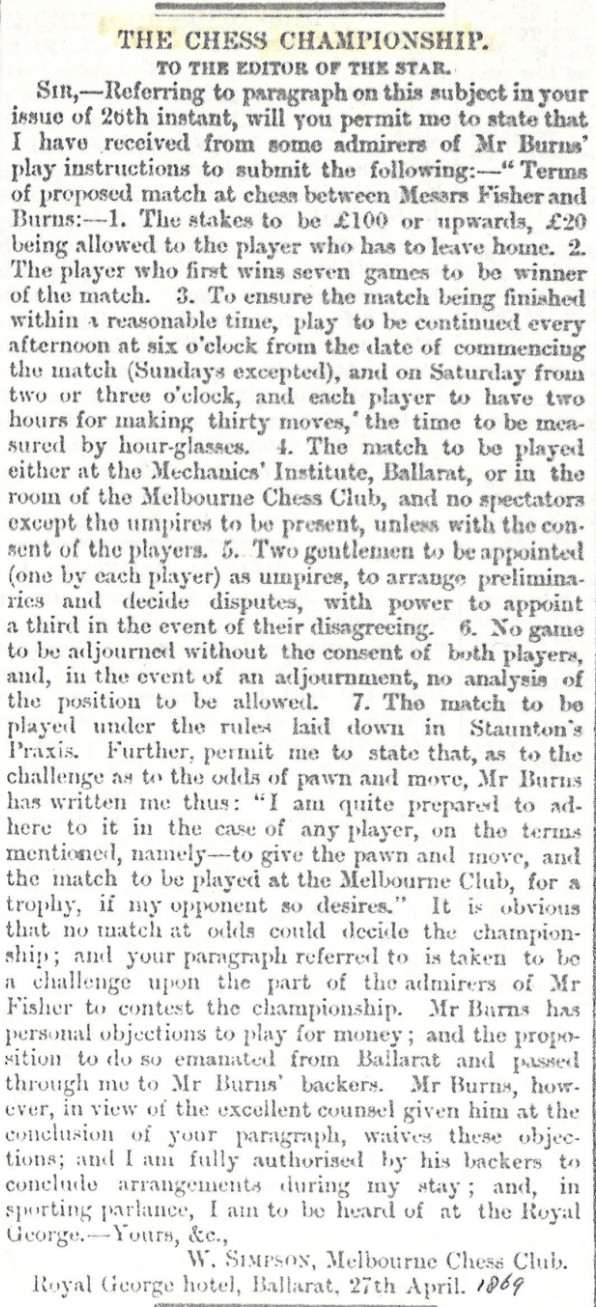
Read the full Star article here... open image
Letter from W. Simpson, Melbourne Chess Club
“Sir, — Referring to the paragraph on this subject in your issue of 26th instant, will you permit me to state that I have received from some admirers of Mr Burns’ play instructions to submit the following:
Terms of proposed match at chess between Messrs Fisher and Burns:
1. The stake to be £100 or upwards, £20 being allowed to the player who has to leave home.
2. The player who first wins seven games to be winner of the match.
3. To ensure the match being finished within a reasonable time, play to be continued every afternoon at six o’clock from the date of commencing the match (Sundays excepted), and on Saturday from two or three o’clock; and each player to have two hours for making thirty moves, the time to be measured by hour-glasses.
4. The match to be played either at the Mechanics’ Institute, Ballarat, or in the room of the Melbourne Chess Club, and no spectators except the umpires to be present, unless with the consent of the players.
5. Two gentlemen to be appointed (one by each player) as umpires, to arrange preliminaries and decide disputes, with power to appoint a third in the event of their disagreeing.
6. No game to be adjourned without the consent of both players; and in the event of adjournment, no analysis of the position to be allowed.
7. The match to be played under the rules laid down in Staunton’s Praxis.
Further, permit me to state that, as to the challenge as to the odds of pawn and move, Mr Burns has written me thus: “I am quite prepared to adhere to it in the case of any player, on the terms mentioned — namely, to give the pawn and move, and the match to be played at the Melbourne Club, for a trophy, if my opponent so desires.”
It is obvious that no match at odds and move could decide the championship; and your paragraph referred to is taken to be a challenge upon the part of the admirers of Mr Fisher to contest the championship.
Mr Burns has personal objections to play for money; and the proposition to do so emanated from Ballarat and passed through me to Mr Burns’ backers. Mr Burns, however, in view of the excellent counsel given him at the conclusion of your paragraph, waives these objections; and I am fully authorised by his backers to conclude arrangements during my stay; and in sporting parlance, I am to be heard at the Royal George Hotel. — Yours etc.”
29 April 1869 — The Ballarat Star
Letter from Charles Fisher
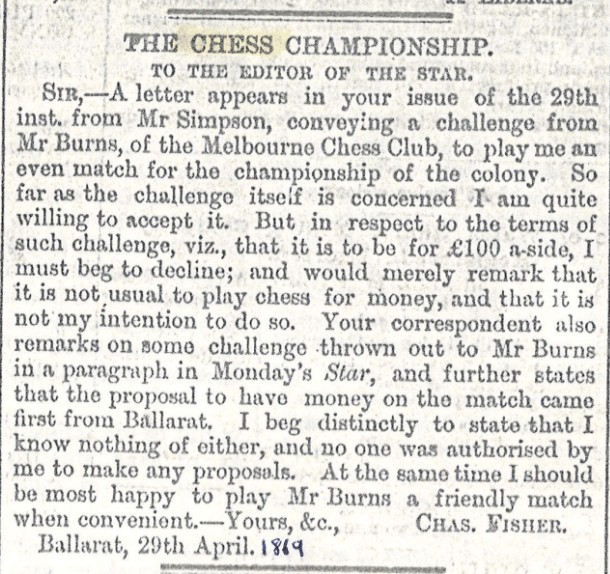
Sir,
A letter appears in your issue of the 29th inst. from Mr Simpson, conveying a challenge from Mr Burns, of the Melbourne Chess Club, to play me an even match for the championship of the colony. So far as the challenge itself is concerned I am quite willing to accept it. But in respect to the terms of such challenge, viz., that it is to be £100 a-side, I must beg to decline; and would merely remark that it is not my intention to do so.
Your correspondent also remarks on some challenge thrown out to Mr Burns in a paragraph in Monday’s Star, and further states that the proposal to have money on the match came first from Ballarat. I beg distinctly to state that I know nothing of either, and no one was authorised by me to make any proposals. At the same time I should be most happy to play Mr Burns a friendly match when convenient.
Yours, etc,
Chas Fisher
Editor’s Note — Bas van Riel:
By 1875 there was little doubt that the 3 strongest players in Australia were Andrew Burns, Louis Goldsmith, and Charles Fisher. In that year Goldsmith and Fisher played, for a stake of £20 a side, the first notable match over the board between a Victorian and a player from another colony. The match, played in Melbourne club, drew many spectators and was narrowly won by Fisher. When Blackburne visited Australia in 1885, Fisher alone held the British master to a draw on level terms.
Fisher returned to Ballarat in 1884 to give a demonstration of simultaneous play and an uproar was caused when an official of the Institute turned the gas out on him. It was reported in the Ballarat Courier (21st March 1884)* and reprinted in Fisher’s column in the Australasian the following week. More about that in the “Smoking-Room Incident” in the Spielvogel Era page.

Charles Fisher — Australian Champion 1875
Fisher vs Goldsmith — Melbourne, 1875
Editor’s Note — RL: Here is an exciting game played in Melbourne in 1875 between Charles M. Fisher and Louis Goldsmith. 11 games to view between Fisher and Goldsmith can be enjoyed here ... (Resize viewing board by dragging right side of board)
April 29 1890 - The death of Charles Fisher in Monte Carlo
Leader, Saturday 10 May 1890 — page 7
DEATH OF MR. C. M. FISHER.
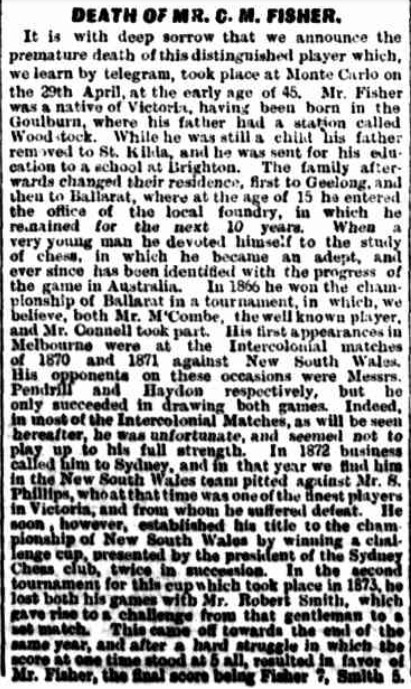
It is with deep sorrow that we announce the premature death of this distinguished player which, we learn by telegram, took place at Monte Carlo on the 29th April, at the early age of 45. Mr. Fisher was a native of Victoria, having been born in the Goulburn, where his father had a station called Woodstock. While he was still a child his father removed to St. Kilda, and he was sent for his education to a school at Brighton. The family afterwards changed their residence, first to Geelong, and then to Ballarat, where at the age of 15 he entered the office of the local foundry, in which he remained for the next 10 years.
When a very young man he devoted himself to the study of chess, in which he became an adept, and ever since has been identified with the progress of the game in Australia. In 1866, he won the championship of Ballarat in a tournament, in which, we believe, both Mr. M’Combe, the well known player, and Mr. Connor took part. His first appearances in Melbourne were at the Intercolonial matches of 1870 and 1871 against New South Wales. His opponents on these occasions were Messrs. Pendrill and Haydon, respectively, but he only succeeded in drawing both games. Indeed, in most of the Intercolonial Matches, as will be seen hereafter, he was unfortunate, and seemed not to play up to his full strength.
In 1872 business called him to Sydney, and in that year we find him in the New South Wales team pitted against Mr. S. Phillips, who at that time was one of the finest players in Victoria, and from whom he suffered defeat. He soon, however, established his title to the championship of New South Wales by winning a challenge cup, presented by the president of the Sydney Chess Club, twice in succession.
In the second tournament for this cup which took place in 1873, he lost both his games with Mr. Robert Smith, which gave rise to a challenge from that gentleman to a match. This came off towards the end of the same year, and after a hard struggle in which the score at one time stood at 5 all, resulted in favour of Mr. Fisher, the final score being Fisher 7, Smith 5.
In the Intercolonial matches of 1873 and 1874 he again appeared in the New South Wales team, his opponent on both occasions being Mr. Stephen, and won both games. Early in the following year, 1875, he paid a long visit to Melbourne, during which a match was arranged between him and Mr. L. Goldsmith, to be decided by the winning of 5 games. This match proved to be the closest and most exciting that has occurred in Australia. At one time it seemed as if Mr. Goldsmith was to have a somewhat easy victory, the score standing at Goldsmith 4, Fisher 2, but the latter proved himself equal to the occasion, and though six more games were played before the match was decided, he did not allow his opponent to win another game, the final score being Fisher 5, Goldsmith 4, drawn 3.
In the Intercolonial match of the following year he was drawn against Mr. Burns, the result being one of the finest games ever played in Australia, which was scored by Mr. Burns. In the same year he again came out first in the handicap tourney at the Sydney Club, Mr. Crane being second. In consequence of his repeated victories he was very heavily handicapped in the tourney of 1877, having to give Mr. Crane the odds of pawn and move. Notwithstanding this he won both his games with that player, and once more carried off the first prize.
Strange to say, though he must at the time have been in excellent form, he suffered a third defeat in the Intercolonial match of the same year, his opponent on that occasion being Mr. Stanley. After this he appears to have relaxed his efforts somewhat, as we find him in the Sydney handicap of 1878 taking only third place, Mr. Ryan, to whom he gave the pawn and move, being first, and Mr. Slade second. In this tourney, however, he was again successful against Mr. Crane at the same odds.
The result of the handicap of the following year shows that he must have been quite out of form, as he was not even placed, Mr. Crane who received the pawn and move, taking first honours. This surmise is confirmed by the fact that he declined to play in the Intercolonial match of May 1880, evidently feeling that he could not do himself justice.
Shortly afterwards he returned to Victoria, and in the Intercolonial match of 1883 again took his place in the Melbourne team, his opponent being Mr. Crane, with whom he drew. For some time after his return he took little part in chess matters, being absorbed in mining speculations, but in 1884, having been appointed chess editor to a weekly contemporary, he returned to chess circles, and resumed practice of the game.
In this year he entered as a competitor for the challenge in a tourney at the Melbourne Chess Club, but was unsuccessful, having been defeated by both Mr. Burns and Mr. Gossip. In the following year, however, he retrieved his laurels, and carried off the cup, following up this success by winning it a second time in 1886, when it became his absolute property. By these victories he established his claim to the championship of Victoria.
Since that time, being engaged in large speculations in silver in the Stock Exchange, in which he was very successful, he almost entirely withdrew from the chess arena, and took no part in either of the Intercolonial champion matches subsequently held in Adelaide and Melbourne.
Besides being a fine player over the board, Mr. Fisher could play very well blindfold, though he never, we believe, attempted the feat, now somewhat common, of conducting several games simultaneously. He was also an excellent judge of problems, which he occasionally composed himself. As a chess editor, he was distinguished by invariable courtesy and keen powers of analysis.
At the beginning of last year he determined to pay a visit to England, which he had never seen, and sailed with his wife and family in the month of March. On his arrival, he found his way to the chess clubs of London and Paris, and met with considerable success in his encounters with the amateurs whom he met, though we are not aware that he crossed swords with any of the recognised champions.
To escape the rigors of an English winter he went to the south of France, and up to the date of his last letters appeared to be in good health and spirits, talking of an early return to Victoria. The telegram announcing his death has therefore come with a painful shock to his relatives and friends, who were looking forward to an early happy reunion.
In private life Mr. Fisher was a pleasant and lively companion, and his cheery presence will be much missed at the club room as well as by a large circle of friends. But to his own family, his loss is irreparable. In all his domestic relations he was most exemplary — a good and generous son to his aged parents, who are both alive; a kind brother and an affectionate husband and father. He leaves a widow and two young daughters to mourn his untimely death.
Australasian, Saturday 9 August 1890 — page 12
THE LATE C. H. FISHER.
A private letter has been placed at our disposal from which we have compiled the following account of the closing months of Mr. C. M. Fisher’s life:— He went to Paris at the end of last October, and remained there for about five weeks, during the whole of which he was in the best of health. At the beginning of December he visited Fryeburg, for the purpose of inspecting the mining machinery of the place. From Freiburg he went to Berlin, where he found the cold so intense that he proceeded to Vienna with the intention of returning to Paris southward. But when he reached Vienna the place was blocked with snow, and the train by which he travelled was the last to arrive. For four days nothing could leave the town. He therefore decided to change his route, and to return to Paris as speedily as possible. He arrived there suffering from a frightful cold and from bronchitis, and found his wife and children prostrate with the prevailing epidemic of influenza.
As soon as they were able to travel they proceeded to Nice, where for the first three or four weeks Mr. Fisher’s health was splendid. He then began to complain of sleepiness and of headache. After a little while he was persuaded to consult an English physician, who pronounced the pain in the head to be neuralgic (?BvR), prescribed generous food, with as much open-air life as possible, and directed that Mr. Fisher should not be allowed to give way to his tendency to go to sleep. As, however, he still continued to complain of pain in his head, he was recommended to go to Monte Carlo.
He had been there only a week when he was suddenly prostrated by an attack which a German doctor, who was staying at the hotel, pronounced to be paralysis of the left side, accompanied by slight haemorrhage on the brain. The attack had been induced by the incorrect treatment which had followed on the earlier warning symptoms of sleepiness and pain in the head. After a short time an English doctor was called in, and under his care Mr. Fisher’s health speedily began to improve. In the course of a little while he was able to discuss business matters with his wife.
He was wonderfully well on Tuesday, April 22, and went out for a short drive, during which he caught a slight cold. Three days afterwards he seemed so much better that the doctor told him he might look forward to being taken to Aix les Baines in about a week. A few hours later, at midnight, Mrs. Fisher thought that he moved in his sleep, and on going to him she found him unconscious, and perspiring profusely. The doctor, who lived close by, was promptly in attendance, and saw at once that there was a fresh haemorrhage. Other medical men were called in consultation, and everything that was possible was done to save Mr. Fisher’s life.
On the morning of Sunday, April 27, he seemed much better, and it was thought that there was a chance of his living. But in the evening he was worse, and on the following morning it was evident that the end was near at hand. He lingered, however, for about 24 hours, and died early on the morning of Tuesday, April 29.
Mrs. Fisher was desirous of arranging for the transport of the body to Melbourne, so that it might rest in the St Kilda Cemetery. But the difficulties in the way were so great that she was compelled to abandon the idea, and to consent that the body should be laid in the pretty little cemetery of Monaco.
Mr. Fisher’s will was proved a few weeks ago at £46,910. Hence, says the “Adelaide Observer,” the deceased chess-player may not inappropriately be called the Kolisch of Australia. Fisher and Kolisch were nearly the same age, the latter being the elder of the two, and both died in Europe, Kolisch near Vienna on April 29, 1889, and Fisher on exactly the same day of the same month a year afterwards at Monte Carlo.
Both were brilliant chess players, genial in disposition and popular with their fellows. Both retired from the chess arena, and concentrating their intellects upon business, speedily made a fortune, yet each never ceased to cherish a strong regard for the game, and liberally supported all projects for its advancement. Kolisch, by winning the Emperor’s prize in Paris in 1867, became the champion of the world, and Fisher at one time was probably the best player in Australia.
NB: Ignaz Kolisch (later Baron) was born at Pressburg in the year 1837 and was regarded by Steinitz and others as one of the strongest players of the world. He challenged Morphy in 1867 for the world title but Morphy declined, saying that he regarded Anderssen and Paulsen to be stronger than K.
Kolisch’s biggest triumph was to win the Emperor Tournament in 1867, ahead of Winawer (2) and Steinitz (3).