The Nathan Spielvogel Era, 1881 - 1963
Editor’s Note — Bas van Riel:
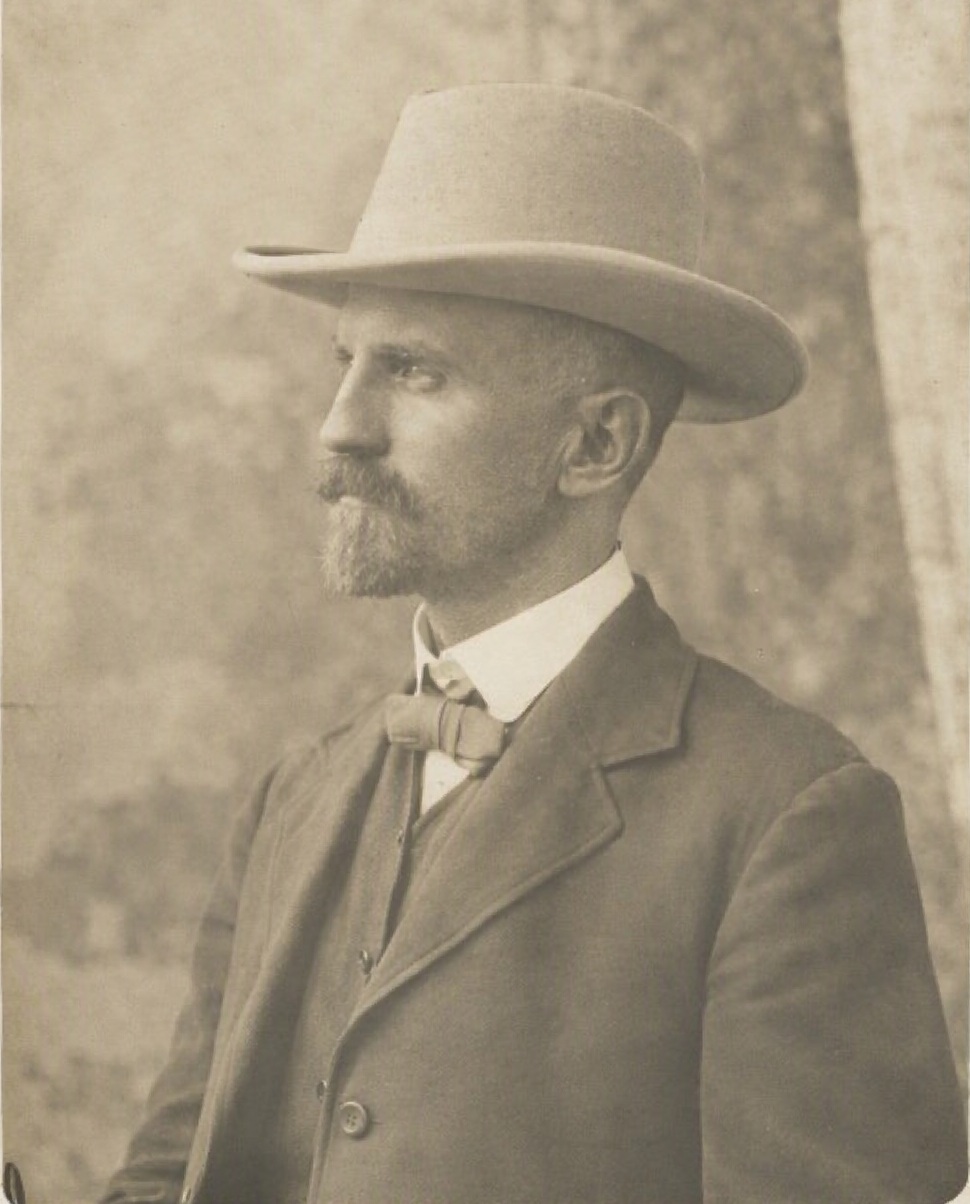
Sherwood Orbost, 'Nathan F. Spielvogel, teacher, writer and historian', photograph, ca. 1925, State Library of New South Wales, P1/1615
After references to chess activities in Ballarat ceased in the Australasian in 1872, the Ballarat Directory for 1875 reported that chess and draughts were listed among the activities of the Mechanics Institute. Nathan Spielvogel noted in his compilation of the History of the Mechanics Institute that in 1880 a chess club was formed, and a room was set aside three nights a week for the exclusive use of the chess club members.
With club meetings recorded at the Mechanics Institute in 1865, 1875, 1885 and 1895, it seems clear that the Institute’s records would be a valuable source for further research.
A publication by E. I. Rosenblum in 1926 briefly described the Ballarat Chess Club and some of its notable members. T. Taylor and W. Tullidge played in interstate matches, and Lampe played in the 1888 Congress. Rosenblum also noted that the club was revived on 12 December 1892 (N. Spielvogel) for a period of eight years. The club’s best result during those years was a drawn match against an almost full-strength Melbourne Chess Club in 1894 (BvR: any reporting?).
Among its strongest players were J. Armstrong (3rd in the 1915 Victorian Championship and an interstate representative), N. Spielvogel (4th in the 1918 Victorian Championship and an interstate representative), and probably the best of them all, Herbert Lockett — though business commitments kept him away from chess.
The final reference for the 1800s appears in the Australian Chess Annual, which noted that “this is a club within the circle of members of the Ballarat Mechanics Institute and there is play daily”.
After 1900 the club faded away, but it was reformed and very active in the mid‑1920s, with an enthusiastic committee led by President J. C. Fletcher and Secretary N. F. Spielvogel. A Championship was played in 1924, won by a young Ernest Greenhalgh. The famous Ballarat versus Geelong matches were played in 1925 and 1926 — no small achievement in an age long before mass transportation.
In 2011 the clubs revived the practice and now hold an annual Challenge match over ten boards. In fact, the 2014 match was played in the very same room (the Smoking-Room referred to below in the Smoking-Room Incident) as that first historic encounter.
Bas van Riel

22 November 1880 – Ballarat Mechanics’ Institute
Request to the Ballarat Mechanics' Institute to make a room available.
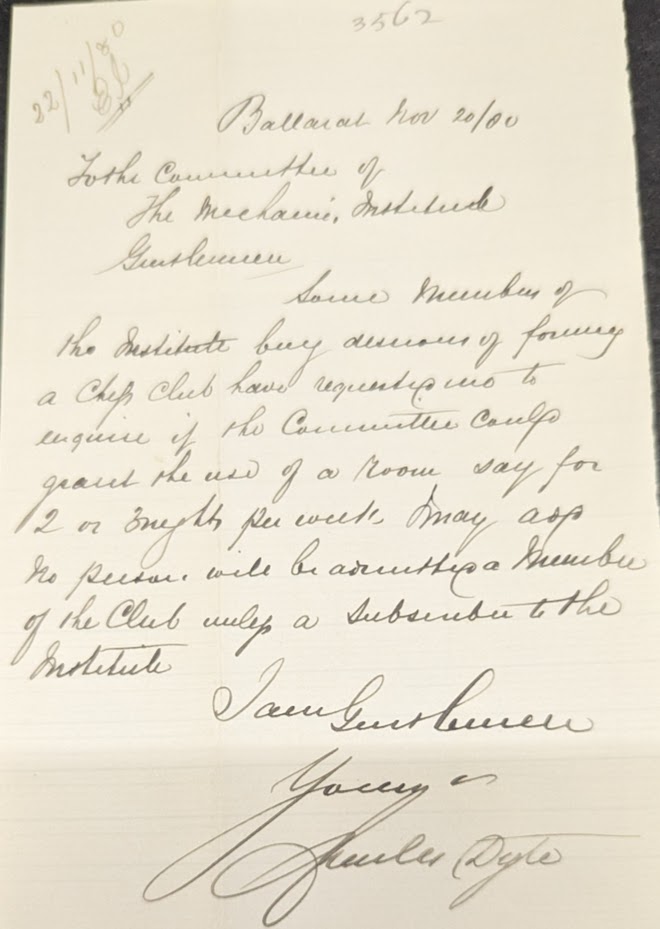
Ballarat 20/11 To the Committee of the Mechanics' Institute
Gentlemen
Some members of the Institute being desirous of forming a Chess Club have requested us to enquire if the Committee could provide the use of a room say for 2 or 3 nights per week, (illeg) no person will be authorised a Member of the Club unless a subscriber to the Institute.
I am gratefully
Yours, ? Doyle?
24 April 1882 – Ballarat Mechanics’ Institute
Request to organise a match against the Smythesdale & Scarsdale Mechanic Institutes
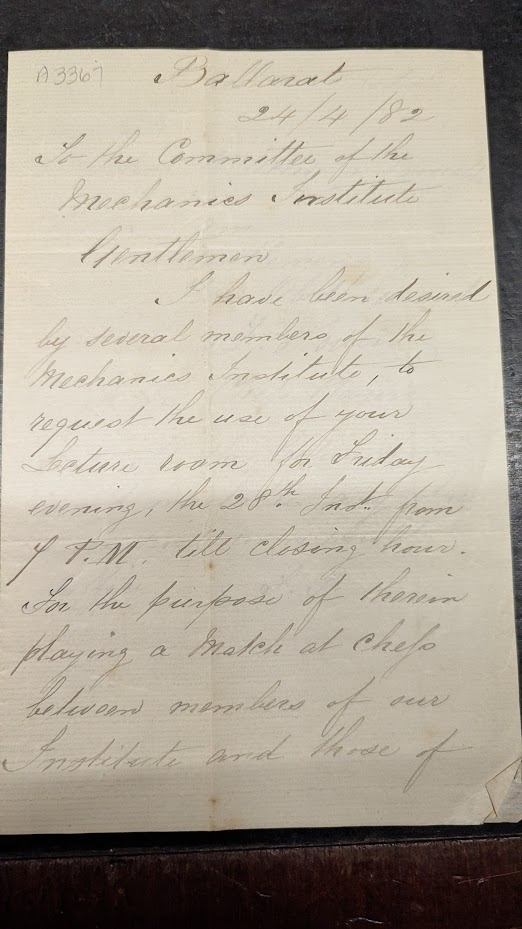
Ballarat 24/4/82 To the Committee of the Mechanics Institute
Gentlemen
I have been desired by several members of the Mechanics Institute, to request the use of your Lecture Room for Friday evening, the 28th July from 4.P.M. till closing hour, for the purpose of therein playing a Match of Chess between members of our Institute and those of the Smythesdale & Scarsdale Mechanic Institutes.
Yours, W.G.Finlayson
March 1884: The Smoking-Room Incident

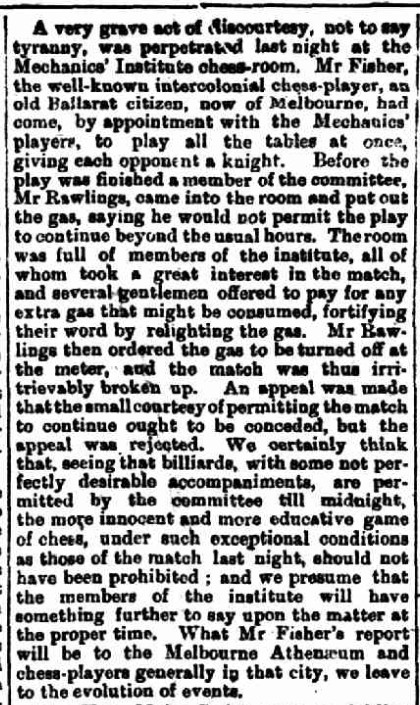
The Ballarat Courier — 21st March 1884
“A very grave act of discourtesy, not to say tyranny, was perpetrated last night at the Mechanics’ Institute chess-room. Mr. Fisher, the well-known intercolonial chess-player, an old Ballarat citizen, now of Melbourne, had come by appointment with the Mechanics’ players, to play all the tables at once, giving each opponent a knight.
Before the play was finished, a member of the committee, Mr. Rawlings, came into the room and put out the gas, saying he would not permit the play to continue beyond the usual hours. The room was full of members of the institute, all of whom took a great interest in the match, and several gentlemen offered to pay for any extra gas that might be consumed, fortifying their word by relighting the gas.
Mr. Rawlings then ordered the gas to be turned off at the meter and the match was thus irretrievably broken up. An appeal was made that the small courtesy of permitting the match to continue ought to be conceded, but the appeal was rejected.
We certainly think that, seeing that billiards, with some not perfectly desirable accompaniments, are permitted by the committee till midnight, the more innocent and more educative game of chess under such exceptional conditions as those of the match last night, should not have been prohibited; and we presume that the members of the Institute will have something further to say upon the matter at the proper time.
What Mr. Fisher’s report will be to the Melbourne Athenaeum and chess players generally in that city, we leave to the evolution of events.”
Editor’s Note — Rob Loveband:
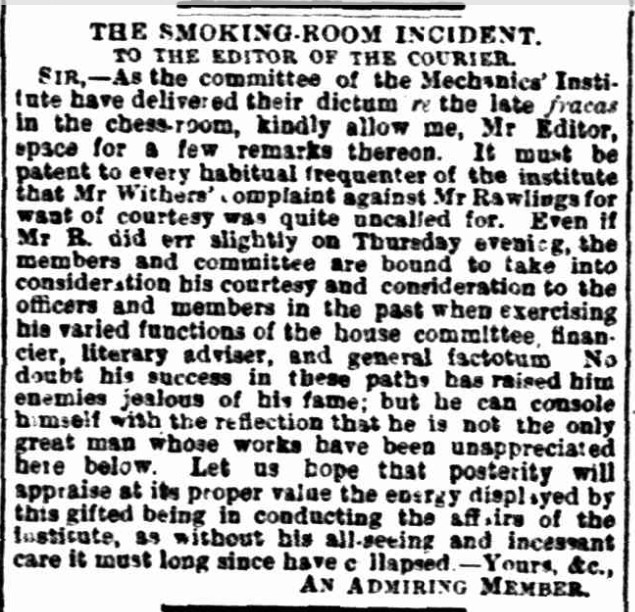
In response to the letter regarding “a very grave act of discourtesy” by Mr Rawlings, who turned off the gas lighting, a Mechanics’ Institute member stood up for “Mr R”, saying:
The Smoking-Room Incident
To the editor of the Courier
SIR, As the committee of the Mechanics’ Institute have delivered their dictum re the late fracas in the chess-room, kindly allow me, Mr Editor, space for a few remarks thereon. It must be patent to every habitual frequenter of the institute that Mr Withers’ complaint against Mr Rawlings for want of courtesy was quite uncalled for.
Even if Mr R. did err slightly on Thursday evening, the members and committee are bound to take into consideration his courtesy and consideration to the officers and members in the past when exercising his varied functions of the house committee, financier, literary adviser, and general factotum.
No doubt his success in these paths has raised him enemies jealous of his fame; but he can console himself with the reflection that he is not the only great man whose works have been unappreciated here below. Let us hope that posterity will appraise at its proper value the energy displayed by this gifted being in conducting the affairs of the Institute, as without his all-seeing and incessant care it must long since have collapsed.
Yours, &c.,
An Admiring Member
20th Feb 1886 — The Australasian
The tournament of the Melbourne Chess Club, which has been in progress for some time past, was brought to a conclusion in the club’s rooms in the Victoria Coffee Palace, on Monday evening. The two final players were Mr. C. N. Fisher and Mr. A. Burns, who competed for the chess championship of the Colony. The result was a victory for Mr. Fisher, who thus became the winner of the silver challenge cup. Mr. Fisher won every game which he played in the tournament, and Mr. Burns lost two games. Thus for the first time for years the championship has passed from Mr. Burns.
The cup has to be won twice before becoming the property of any player.
2 August 1890 – Ballarat Mechanics’ Institute
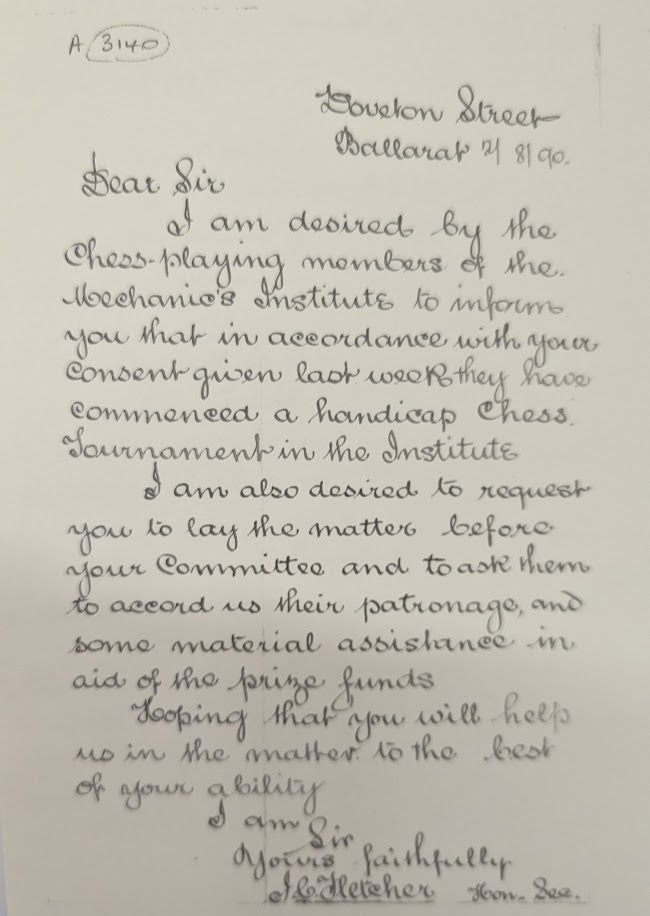
Request by J.C.Fletcher for patronage from BMI to help with prize funds for a handicap chess tournament.
Doveton Street
Ballarat 2/8/90
Dear Sir
I am desired by the chess playing members of the Mechanics Institute, to inform you that in accordance with your consent given last week they have commenced a handicap Chess Tournament in the Institute.
I am also desired to request you to lay the matter before your committee and to ask them to accord us their patronage and some material assistance in aid of the prize funds.
Hoping that you will help us in the matter to the best of you ability,
I am, Sir
Yours Faithfully,
J.C.Fletcher Hon. Sec.
2 December 1892 – Ballarat Mechanics’ Institute
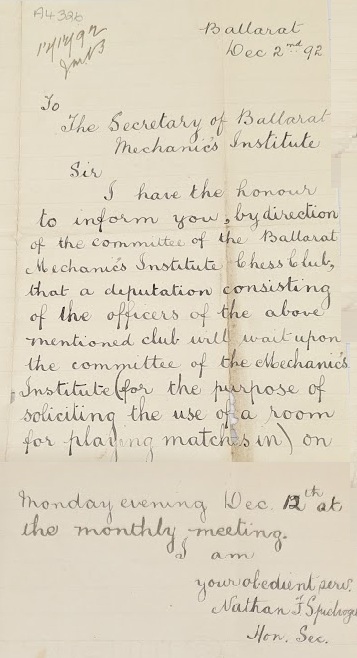
Letter from Nathan Spielvogel to the Secretary of the Institute to request use of a room for playing matches on December 12th.
To
The Secretary of Ballarat
Mechanics Institute
Sir
I have the honour to inform you, by direction of the committee of the Ballarat Mechanics Institute Chess Club, that a deputation consisting of the officers of the above mentioned club will wait upon the committee of the Machanics Institute (for the purpose of soliciting the use of a room for playing matches in) on Monday evening Dec 12th at the monthly meeting.
I am
Your obedient serv.
Nathan F Spielvogel
Hon. Sec.
20 December 1892 – Ballarat Mechanics’ Institute
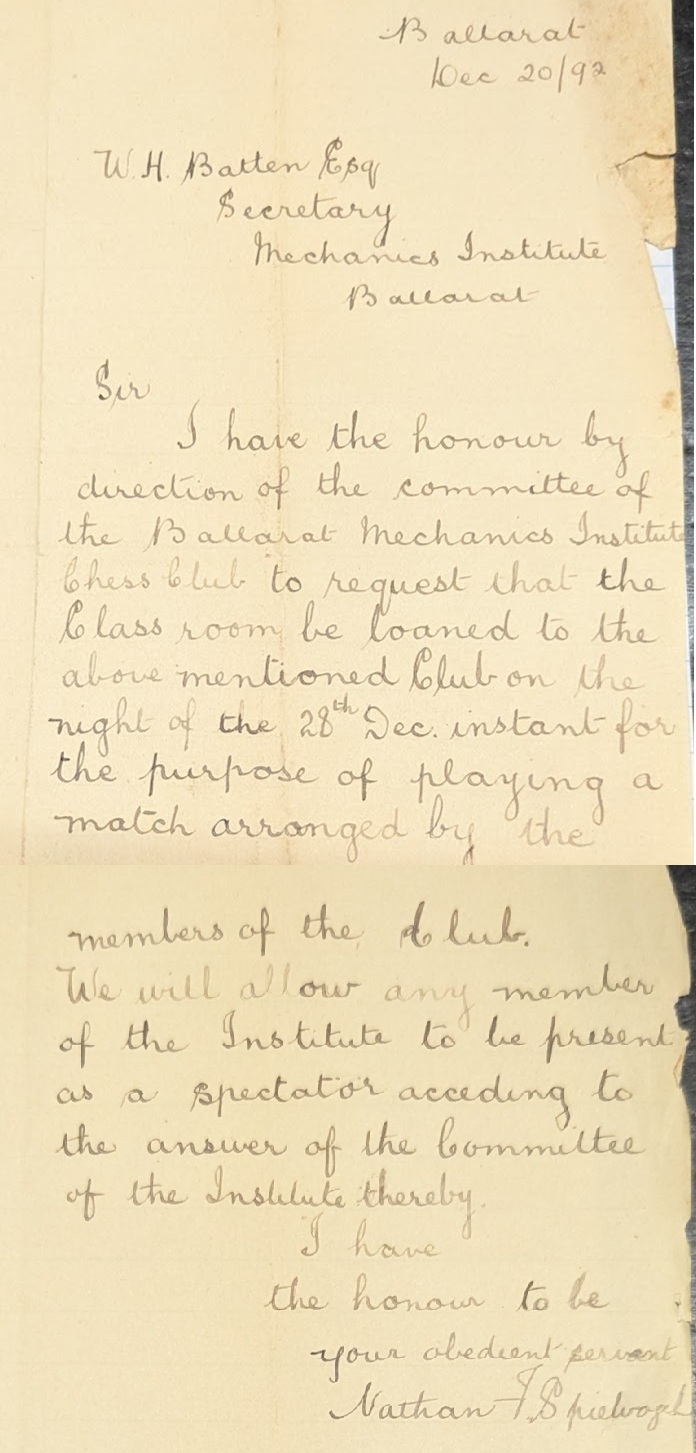
Letter from Nathan Spielvogel to the W.H.Batten, Secretary of the Institute to request use of the 'Class room' for a Match to be held on December 28th, one week thence.
W.H.Batten Esq
Secretary
Mechanics Institute
Ballarat
Sir
I have the honour by direction of the committee of the Ballarat Mechanics Institute Chess Club to request that the Class room be loaned to the above mentioned Club on the night of the 28th Dec. instant for the purpose of playing a match arranged by the members of the Club.
We will allow any member of the Institute to be present as a spectator acceding to the answer of the Committee of the Institute thereby.
I have
the honour to be
Your obedient servant
Nathan F Spielvogel
15th Aug 1893 — The Ballarat Star
Among the many clubs and amusements in Ballarat, not the least intellectual and refined is the Ballarat Chess Club in connection with the Mechanics’ Institute. It is the only chess club in Victoria outside Melbourne, and its promoters and officers deserve great praise for the energy and enthusiasm displayed in thus bringing the “King of games” to the front. The club has been formed but nine months, but still it has on the rolls over 30 subscribing members, all trying to bring more members, and all working for the interest of the game.
The club has just concluded an interesting handicap tourney, the first of a series of monthly tournaments, which was won by Mr Lockett; Mr Abrahams close up second. Another tournament commences this day, and among the list of entries are some of the best players in the district. The following handicaps have been declared:
Scratch — Lockett, Lampe.
Pawn and move — Clarke, Abrahams, Brestow.
Pawn and two moves — Crowe, Showman, Archer, Boake.
Knight — Richards, N. F. Spielvogel.
Knight and move — Barker.
Rook — S. Spielvogel, Knight.
23 Aug 1893 The Ballarat Star
The second round of the chess tourney of the Ballarat Chess Club was continued last evening at the Mechanics’ Institute. Mr Lockett (scratch) played Mr Barker (knight and move), and after a short struggle defeated him. Mr Archer played Mr Crowe both playing scratch, and won rather easily. Mr Clarke allowed Mr N. F. Spielvogel pawn and two moves. The latter played very carelessly, giving away two pieces without any necessity. Mr Clatke won in rather less than an hour.

17 November 1894 – Bendigo Advertiser
Chess Match of Melbourne versus Country Victoria (held 9 Nov. 1 p.m.)
Town v. Country
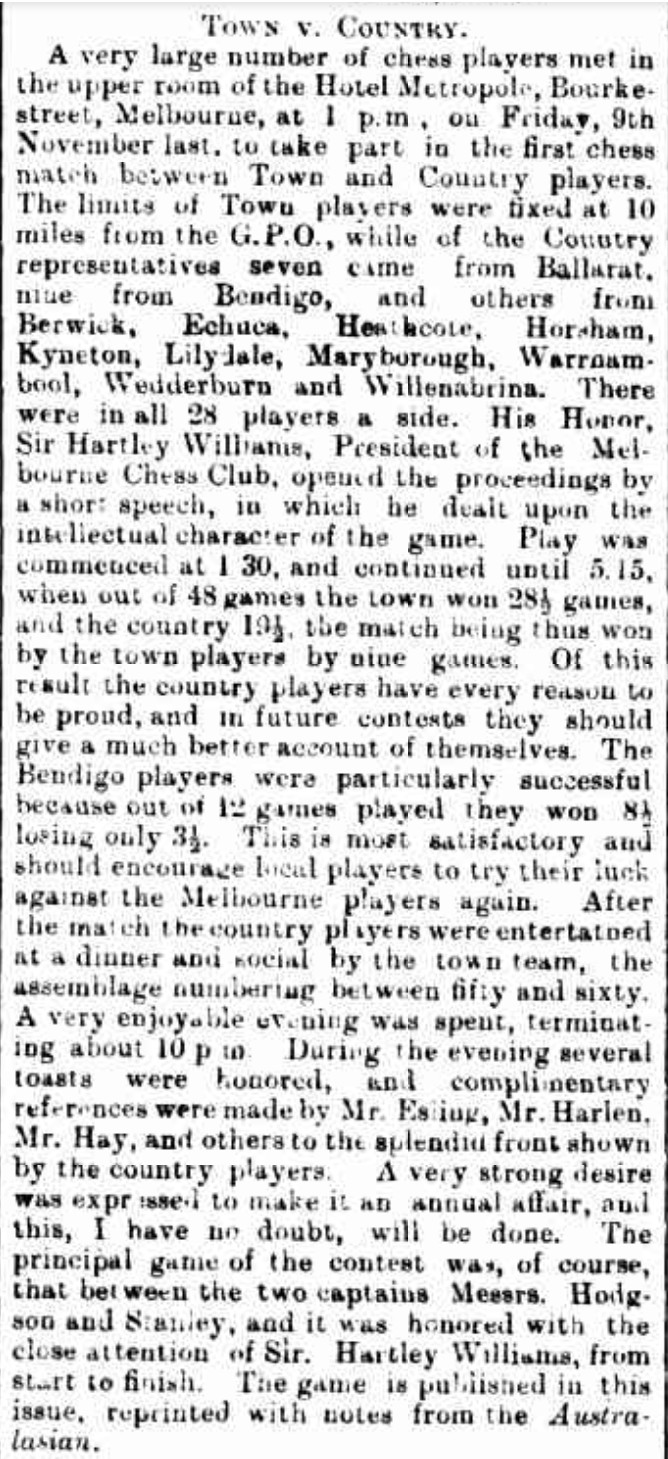
A very large number of chess players met in the upper room of the Hotel Metropole, Bourke Street, Melbourne, at 1 p.m. on Friday, 9th November last, to take part in the first chess match between Town and Country players. The limits of Town players were fixed at 10 miles from the G.P.O., while of the Country representatives seven came from Ballarat, nine from Bendigo, and others from Berwick, Echuca, Heathcote, Horsham, Kyneton, Lilydale, Maryborough, Warrnambool, Wedderburn and Willlenabrina.
There were in all 28 players a side. His Honour Sir Hartley Williams, President of the Melbourne Chess Club, opened the proceedings by a short speech, in which he dwelt upon the intellectual character of the game. Play commenced at 1.30 p.m. and continued until 5.15 p.m., when out of 48 games the town won 28.5 games and the country 19.5, the match thus being won by the town players by nine games.
Of this result the country players have every reason to be proud, and in future contests they should give a much better account of themselves. The Bendigo players were particularly successful because out of 12 games played they won 8.5, losing only 3.5. This is most satisfactory and should encourage local players to try their luck against the Melbourne players again.
After the match the country players were entertained at a dinner and social by the town team, the assemblage numbering between fifty and sixty. A very enjoyable evening was spent, terminating about 10 p.m. During the evening several toasts were honoured, and complimentary references were made by Mr. Esling, Mr. Harlen, Mr. Hay, and others to the splendid front shown by the country players. A very strong desire was expressed to make it an annual affair, and this, I have no doubt, will be done.
The principal game of the contest was, of course, that between the two captains, Messrs. Hodgson and Stanley, and it was honoured with the close attention of Sir Hartley Williams from start to finish. The game is published in this issue, reprinted with notes from the Australasian.
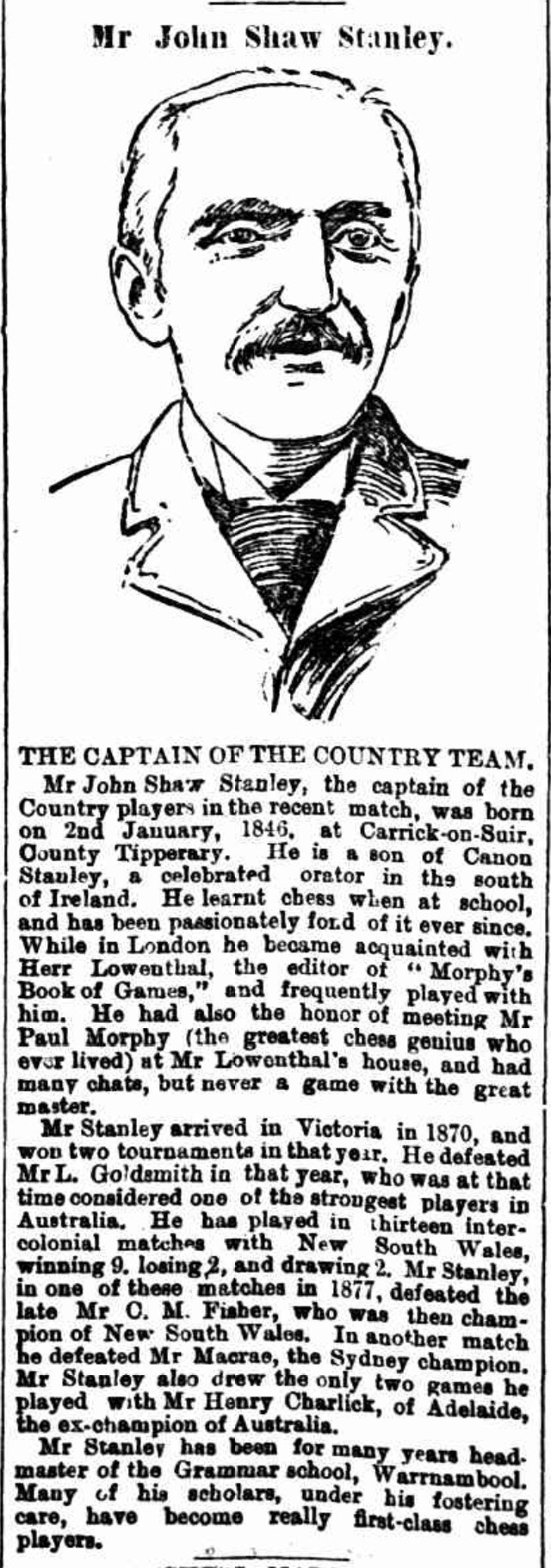
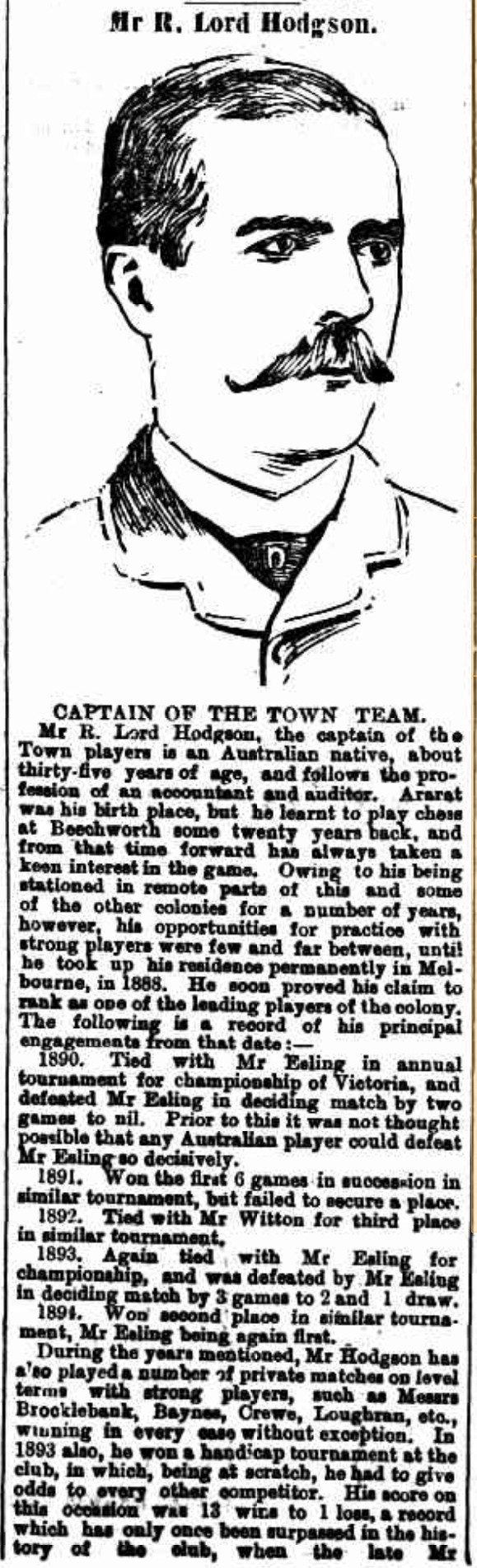
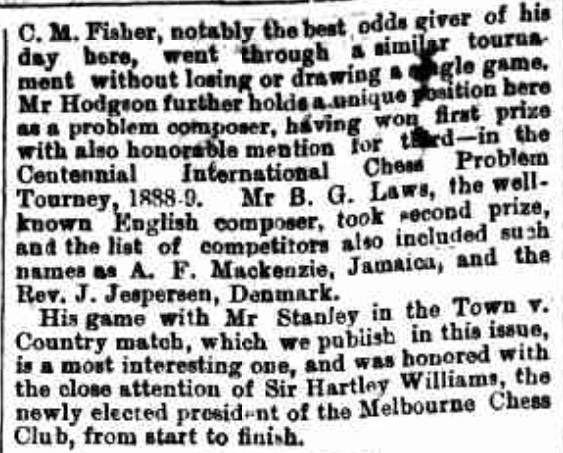
An interesting mention of the late Charles Fisher at the bottom of the Hodgson biography - "In 1893 also, he won a handicap tournament at the club, in which, being at scratch, he had to give odds to every other competitor. His (Hodgson's) score on this occasion was 13 wins to 1 loss, a record which has only been surpassed in the history of the club, when the late Mr C.M.Fisher, notably the best odds giver of the day here, went through a similar tournament without losing of drawing a single game."
17 Nov 1894 — The Weekly Times
Chess Match. Ballarat v. Melbourne.
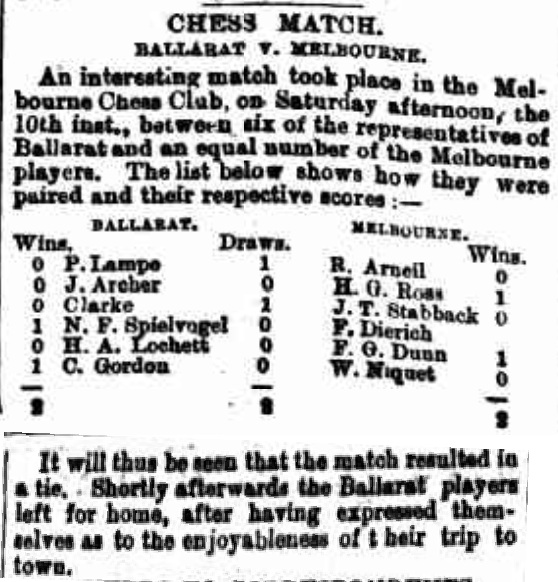
An interesting match took place in the Melbourne Chess Club, on Saturday afternoon, the 10th inst., between six of the representatives of Ballarat and an equal number of the Melbourne players. The list below shows how they were paired and their respective scores: -
| Ballarat v. Melbourne | ||
|---|---|---|
| P. Lampe | ½–½ | R. Arnell |
| J. Archer | 0–1 | H. G. Ross |
| Clarke | ½–½ | J. T. Stabback |
| N. F. Spielvogel | 1–0 | F. Dierich |
| H. A. Lockett | 0–1 | F. G. Dunn |
| C. Gordon | 1–0 | W. Niquet |
It will thus be seen that the match resulted in a tie. Shortly afterwards the Ballarat players left for home, after having expressed themselves as to the enjoyableness of their trip to town.
13th Feb 1895 — The Ballarat Star
The Ballarat Chess Club on Monday visited Learmonth to play a match with the local club. The Ballarat representatives — Messrs Power, Spielvogel (2), W. F. Gordon, and S. Mitchel — gained an easy victory, winning nine games out of 10. The tenth game resulted in a draw. The visitors were hospitably treated, and returned to Ballarat greatly pleased with their outing.
21st Jul 1896 — The Ballarat Star
BALLARAT CHESS CLUB.
The annual meeting was held last week at the Mechanics’ Institute, when 12 members were present, with Mr J. L. Archer (the president) in the chair. The yearly report read by the secretary showed that the club was advancing. It mentioned that the chess congress of the Victorian Country Chess Association, which should have been held in Ballarat last Easter, fell through because of the rather awkward way in which arrangements had been planned. The executive of the Chess Association being in Bendigo and the affair to take place at Ballarat caused a lack of energy and enthusiasm. It is hoped to accomplish the matter next year.
The treasurer furnished a statement of receipts and expenditure, showing 20 financial members, with the result that after paying prizes, trophies, and chess magazine, a balance of £2 5s remained in hand. All present were pleased with the manner in which the club is progressing, and the election of officers for the ensuing year was proceeded with, resulting as follows:—President, Mr J. L. Archer (re-elected); vice-presidents, Messrs J. Rickard and A. W. Crowe (re-elected); treasurer, Mr R. R. Clarke (re-elected); secretary, Mr T. P. Jordan; committee (after a ballot), Messrs C. Gordon, H. Lockett, P. J. Brannagan, P. H. Lampe, and S. Spielvogel.
The members hope to hold a chess club dinner at the conclusion of the tourney for the president’s prize.
Trove link – https://trove.nla.gov.au/newspaper/article/210360449
20 Jan 1897 — The Ballarat Star
Chess Championship of Australia
The chess congress at Warrnambool will be opened on Monday next. In order to induce competitors from various parts of the colony to attend, arrangements are being made for greatly reduced railway fares for accredited players. Bendigo will be represented at the congress by its two best players, Messrs Neale and Roberts.
The Ballarat Chess Club has given a donation towards the prize fund, but it is doubtful whether the club will be represented by any of its members in the tournaments, as owing to the holidays being over the leading players find a difficulty in devoting the necessary time.
The first prize for the minor tourney will be £15, with other prizes in proportion. In the major tourney the first prize will be £50.
18 Feb 1897 — The Ballarat Star
BALLARAT CHESS CLUB
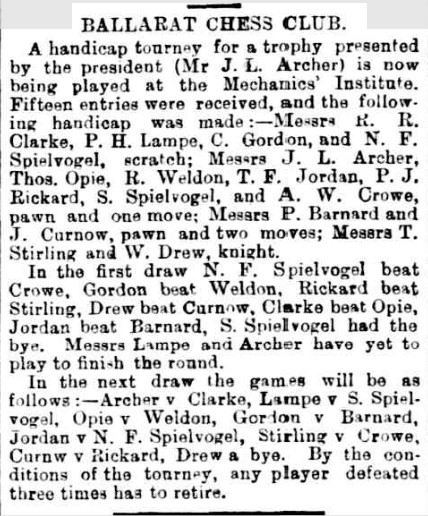
A handicap tourney for a trophy presented by the president (Mr J. L. Archer) is now being played at the Mechanics’ Institute. Fifteen entries were received, and the following handicap was made: — Messrs B. B. Clarke, P. H. Lampe, C. Gordon, and N. F. Spielvogel, scratch; Messrs J. L. Archer, Thos. Opie, B. Weldon, T. F. Jordan, P. J. Rickard, S. Spielvogel, and A. W. Crowe, pawn and one move; Messrs P. Barnard and J. Curnow, pawn and two moves; Messrs T. Stirling and W. Drew, knight.
In the first draw N. F. Spielvogel beat Crowe, Gordon beat Weldon, Rickard beat Stirling, Drew beat Curnow, Clarke beat Opie, Jordan beat Barnard, S. Spielvogel had the bye. Messrs Lampe and Archer have yet to play to finish the round.
In the next draw the games will be as follows: — Archer v Clarke, Lampe v S. Spielvogel, Opie v Weldon, Gordon v Barnard, Jordan v N. F. Spielvogel, Stirling v Crowe, Curnow v Rickard, Drew a bye. By the conditions of the tourney, any player defeated three times has to retire.
18th Sept 1897 — The Weekly Times
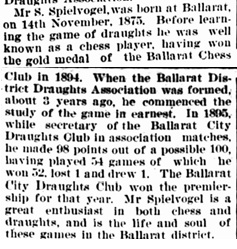
Mr S. Spielvogel (the brother of Nathan Spielvogel) was born in Ballarat, on 14th November, 1875. Before learning the game of draughts he was well known as a chess player, having won the gold medal of the Ballarat Chess Club in 1894. When the Ballarat District Draughts Association was formed, about 3 years ago, he commenced the study of the game in earnest.
In 1895, while secretary of the Ballarat City Draughts Club in association matches, he made 98 points out of a possible 100, having played 54 games of which he won 52, lost 1 and drew 1. The Ballarat City Draughts Club won the premiership for that year. Mr Spielvogel is a great enthusiast in both chess and draughts, and is the life and soul of these games in the Ballarat district.
10 Nov 1897 — The Ballarat Courier
Ballarat Chess Club
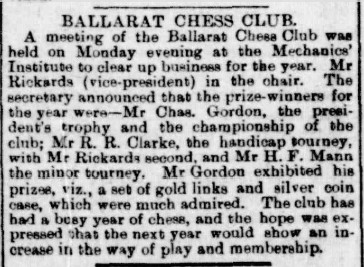
A meeting of the Ballarat Chess Club was held on Monday evening at the Mechanics' Institute to clear up business for the year. Mr Rickards (vice-president) in the chair. The secretary announced that the prize-winners for the year were — Mr Chas. Gordon, the president's trophy and the championship of the club; Mr R. R. Clarke, the handicap tourney, with Mr Rickards second, and Mr H. G. Mann the minor tourney. Mr Gordon exhibited his prizes, viz., a set of gold links and silver coin case, which were much admired.
The club has had a busy year of chess, and the hope was expressed that the next year would show an increase in the way of play and membership.

22 Dec 1897 — The Barrier Miner
Spielvogel visits Broken Hill Chess Club
CHESS NOTES.
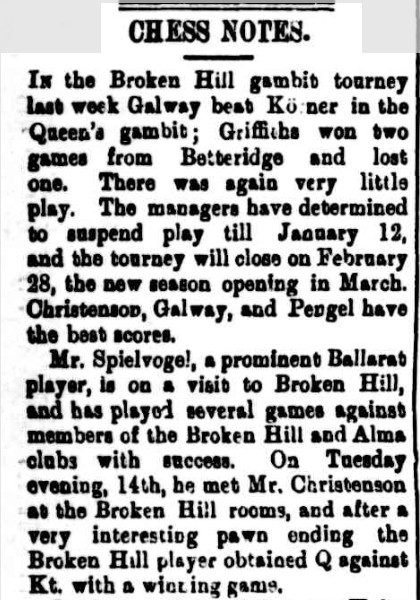
Mr. Spielvogel, a prominent Ballarat player, is on a visit to Broken Hill, and has played several games against members of the Broken Hill and Alma clubs with success. On Tuesday evening, 14th, he met Mr. Christenson at the Broken Hill rooms, and after a very interesting pawn ending the Broken Hill player obtained Queen against Knight, with a winning game.
27 Apr 1899 — The Ballarat Star
CHESS.
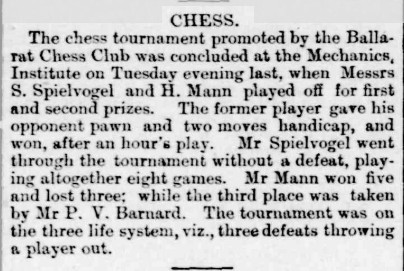
The chess tournament promoted by the Ballarat Chess Club was concluded at the Mechanics’ Institute on Tuesday evening last, when Messrs S. Spielvogel and H. Mann played off for first and second prizes. The former player gave his opponent pawn and two moves handicap, and won, after an hour's play. Mr Spielvogel went through the tournament without a defeat, playing altogether eight games. Mr Mann won five and lost three; while the third place was taken by Mr P. V. Barnard. The tournament was on the three life system, viz., three defeats throwing a player out.
The Ballarat versus Geelong and Melbourne Matches 1925–1926, and other club events those years
4 April 1925 — The Ballarat Courier
The season was opened by the newly formed Mechanics’ Institute Chess Club on Saturday night, when a match was played between teams chosen by the president and the secretary.
At no.1 table Fletcher and Spielvogel had a great struggle. The latter won a pawn early in the game, but Fletcher playing very well managed to secure a draw.
At the second table Odlum won both games from McKay, while at table 3, C. Gordon won both games from Lancaster.
At table 4 a prolonged struggle was fought between Little and Webb. At the call of time the first game was not finished and was adjudicated in favor of Little.
At table 5, Hall won his two games from Hassell. At table 6, Rees had a piece from Martin but just at adjournment time he lost his queen and the game.
The results were:
| President | Secretary |
|---|---|
| Fletcher, J.C. — 1 | Spielvogel, N.F. — 0 |
| Odlum, T. — 2 | McKay, G. — 0 |
| Lancaster, A. — 0 | Gordon, G. — 2 |
| Little, C. — 1 | Webb, F. — 0 |
| Hall, J. — 2 | Hassell, T. — 0 |
| Martin, E. — 1 | Rees, W. — 0 |
| President — 6 | Secretary — 2 |
27 May 1925 – Ballarat Courier
Visit of Mr. Gunderson — Simultaneous Exhibition.
Members of the recently formed Mechanic’s Institute Chess Club considered themselves highly favored when the Secretary (Mr. N. F. Spielvogel) received a reply from Mr. G. Gunderson accepting an invitation to visit Ballarat. Mr. Gunderson for several years was the chess champion of Victoria, and it was realised that exhibition games by him would be very beneficial to the club, particularly to those members who have taken the game comparatively lately.
Instead of playing match games against one or two leading players Mr. Gunderson expressed his desire to give an exhibition of simultaneous chess, stating that if the club wished it, he would engage a dozen or more players at the one time. The strain which such a display entails can well be realised for concentration of thought is one of the essentials to successful chess.
Play commenced at half-past 7 o’clock, twelve boards being arranged in the smoke room of the Institute in parallel rows of six each. These were so placed that Mr. Gunderson could pass along the six boards on one side of the room, and then along to the other six without having to do undue walking from end to end of the room.
Throughout the exhibition he was on his feet, so that the physical tax was no slight one. This combined with his having to adjust his mind to the state of the game at board after board, and move his pieces rapidly while his opponents had ample time to think out their respective moves, added to the severity of his task.
The Ballarat players in the order of which they sat were: Messrs. J. C. Fletcher, E. Martin, E. Greenhalgh, W. Pickford, H. Gordon, T. R. Odlum, A. Pascoe, F. Rauch, J. Hall, N. F. Spielvogel, F. Webb, and C. Gordon. Arrangements had been made for a number of spectators to witness the play, and they were greatly interested in the proceedings.
Play had been in progress for an hour and three quarters before the first result was made known, the visitor claiming first win against Rauch. Five minutes later he had his second, checkmating Pascoe with the rooks in parallel files.
At 20 to 10 H. Gordon failed to keep his opponent’s queen at bay, and lost. Five minutes later Gunderson proclaimed his game against Pickford a draw. The visitor had made an obvious error early in the game, and lost his queen, but by fine play he recovered from that disadvantage, and the game closed with each player having five pawns to support his king. Pickford, who is one of the latest members to take to the game, was warmly congratulated upon his effort.
Webb was beaten at 10 o’clock. Fletcher was the first winner for the night amongst the locals. He had all the worse of the attack, being for some time on the defence. But after some time he succeeded in turning the tables on Gunderson and won in the end game. Gunderson opened with pawn to king 4, and Fletcher responded with an irregular opening.
Soon after the visitor resigned to Hall and made a draw with Greenhalgh. The next announcement was the defeat of C. Gordon followed by that of Martin. That left only Odlum and Spielvogel playing, but the end soon came, Odlum getting a draw and Spielvogel a win.
| Ballarat | Gunderson |
|---|---|
| C. Gordon — 0 | Gunderson — 1 |
| J. Hall — 1 | Gunderson — 0 |
| E. Greenhalgh — 0.5 | Gunderson — 0.5 |
| E. Martin — 0 | Gunderson — 1 |
| W. Pickford — 0.5 | Gunderson — 0.5 |
| J. C. Fletcher — 1 | Gunderson — 0 |
| N. F. Spielvogel — 1 | Gunderson — 0 |
| F. Rauch — 0 | Gunderson — 1 |
| H. Gordon — 0 | Gunderson — 1 |
| T. R. Odlum — 0.5 | Gunderson — 0.5 |
| A. Pascoe — 0 | Gunderson — 1 |
| F. Webb — 0 | Gunderson — 1 |
| Ballarat — 4.5 | Gunderson — 7.5 |
Prior to the start of play Mr. J. C. Fletcher, president of the club, received Mr. Gunderson, and expressed the pleasure which the members felt at his having come to Ballarat. Mr. Gunderson briefly responded.
At the end of play a hearty vote of thanks was passed to him at the motion of Messrs. N. F. Spielvogel and T. R. Odlum.
Mr. Gunderson said that he was amply repaid for his visit if it served to stimulate chess in Ballarat.
At the close of the evening Mr. Gunderson was entertained at the Wattle.
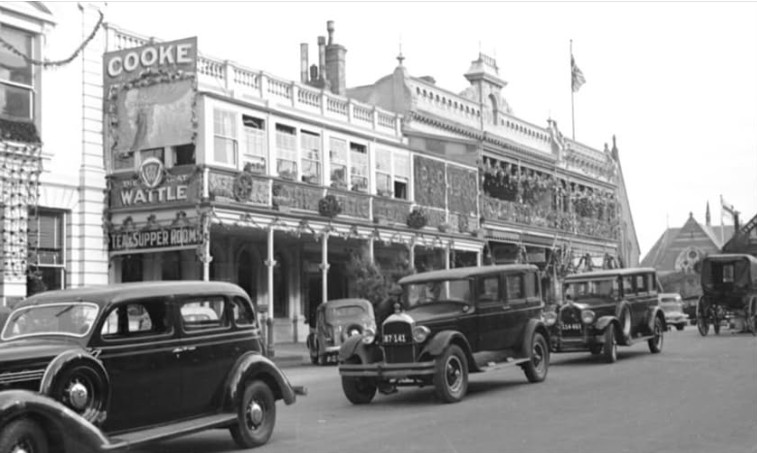
This image of The Wattle Tearooms in Lydiard St South, was taken in 1938 and is sourced from Victorian Collections.

Ballarat plays Geelong. From The Ballarat Courier, 26 April 1925. A photograph capturing the inter‑city match held at the Mechanics' Institute, showing players from both clubs engaged in play on the 23rd of April during the 1925 fixture.

24 April 1925 - Geelong Adveriser
INTERCITY CHESS TOURNAMENT, BALLARAT BEATS GEELONG
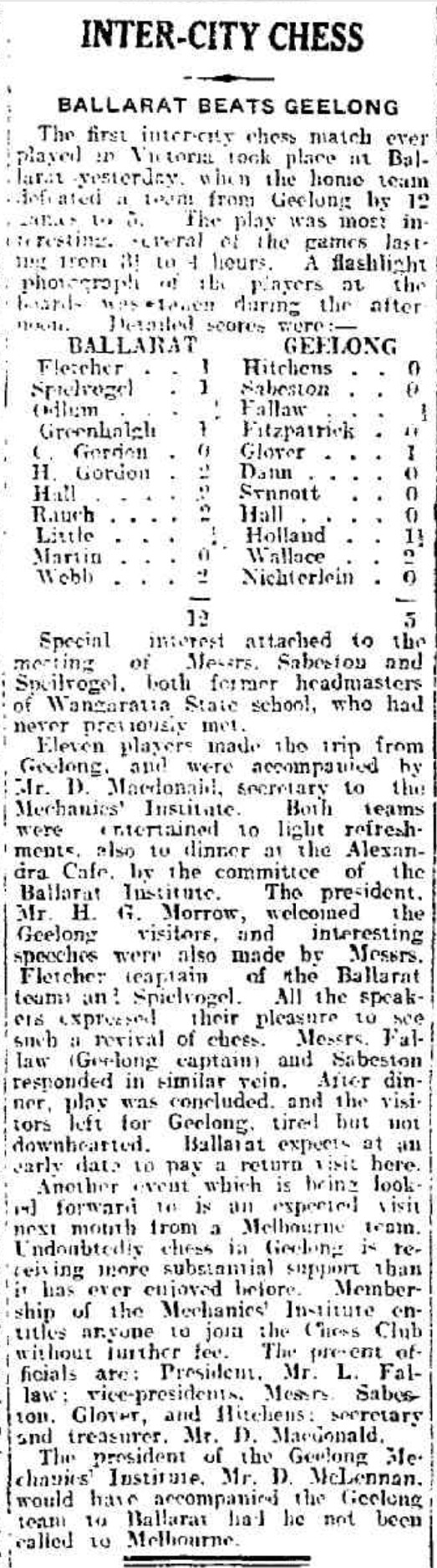
The first intercity Chess match ever played in Victoria took place in Ballarat yesterday, when the home team defeated a team from Geelong by 12 points to 5. The play was most interesting. Several of the games lasted from 3 to 4 hours. A flashlight photograph of the players at the boards was made during the afternoon. Special interest attached to the meeting of Messrs Sabeston and Spielvogel, both former headmasters of Wangaratta State School, who had never previously met.
Eleven players made the trip from Geelong, and were accompanied by Mr. D. MacDonald, secretary to the Mechanics Institute (of Geelong). Both teams were entertained to light refreshments, also to dinner at the Alexandra Cafe, by the Ballarat Institute. The President, Mr H. G. Morrow, welcomed the Geelong visitors, and interesting speeches were also made by Messrs Fletcher, captain of the Ballarat team, and Spielvogel. All the speakers expressed their pleasure to see such a revival of chess. Messrs Fallow (Geelong captain) and Sabeston responded in similar vein.
After dinner, play was concluded and the visitors left for Geelong, tired but not downhearted. Ballarat expects at an early date to play a return visit here (in Geelong). Another event which is being looked forward to is an expected visit next month from a Melbourne team. Undoubtedly, chess in Geelong is receiving more substantial support than it has ever enjoyed before.
Membership of the Mechanics Institute entitles anyone to join the Chess Club without further fee. The present officials are: President, Mr L. Fallow; vice-presidents, Messrs Sabeston, Glover and Hitchens; secretary and treasurer, Mr D. MacDonald. The president of the Geelong Mechanics Institute, Mr D. MacLennon, would have accompanied the Geelong team to Ballarat had he not been called to Melbourne.
20 July 1925 – Ballarat Courier
Melbourne versus Ballarat.
A team from the Melbourne Chess Club will visit Ballarat in August to play the local club. In preparation for this important match team matches will be played each Saturday night in the club room. All members should play in these as the team will be chosen from the most successful players.
The two winter tournaments are now concluded. The Major Tournament which was not a championship as reported in the Metropolitan Press, was won by Greenhalgh, who won six out of seven, losing only to Fletcher. Fletcher, Odlum, and Spielvogel tied for second place, each losing one game and drawing two games.
The Minor Tournament resulted in a tie between Webb and Lancaster. They played a match to decide and Webb won. He becomes an A player now.
A proposal has been made to play a series of correspondence matches against some NSW club.
Mr. Rauch’s class for beginners has not started operations, so there is yet time to hand names in at the Library at the Mechanics’ Institute.
31 August 1925 – Ballarat Courier
Ballarat defeats Melbourne.
On Saturday night a team from the Melbourne Chess Club visited Ballarat and played a match at the Mechanics Institute against the local club. The match commenced at a quarter to eight and was finished at ten fifteen.
At board 1 Greenhalgh played Berman. He opened strongly, and quickly gained an advantage which he pressed home and secured victory.
At Board 2 Spielvogel found Keage a very cautious player, who watched very carefully. Spielvogel gained a pawn and had the better position, but through a weak move lost the pawn again and a draw was agreed on.
At Board 3 Odlum played Pearce, and soon got a strong position, gaining a good win.
At Board 4 Rauch and Biggs had a merry little game, which resulted in a draw.
At Board 5 Hall met Rev. Brain. After some steady play Hall sacrificed a piece for a mating position and won.
At Board 6 Lancaster met Colville. He played rather impulsively and got into a bad position and was forced to resign.
The match resulted in a win for Ballarat: 3 wins, 3 draws, and 1 loss.
The visitors were entertained at supper at the Wattle Palais. Mr. McGregor, President of the Mechanics Institute, was in the chair. He proposed the health of the visitors, and said that chess must be a great cementer of friendships. He condoled with the losers and cordially hoped that they would be the losers in the return match.
Mr. N. F. Spielvogel spoke to the toast. He said the result was of little importance, but the match and similar matches must stimulate interest in the great game.
Mr. Biggs humorously responded to the toast. He said they had one or two other players in the Melbourne Club. He knew all about Ballarat chess now and when the return match came there would be a different story.
7 Sept 1925 — The Ballarat Courier
“Strategist met strategist yesterday afternoon and evening when the chess club of the Mechanics Institute met players of the Geelong Institution in the rooms of the former body. It is some considerable time since the game has been locally played in an inter-city sense, and a great deal of interest centred in it. On Wednesday evening the visitors arrived and were met at the station by Ballarat players. The match commenced yesterday and at the end of the afternoon Ballarat were holding the fort with a substantial majority.
However, a truce was called about 6pm and during a brief armistice, the opposing sides fraternised over an excellent dinner at Brazenor’s Alexandria Café. Mr. H.G. Morrow (President of the Mechanics Institute) presided when the time came around for toasts. He admitted that his knowledge of chess was limited. In fact as far as chess was concerned he appealed for mercy with Messrs Fletcher and Spielvogel (president and secretary of the Ballarat club). He had much pleasure in bidding the visitors welcome. The visit meant a revival of chess and he predicted a big future for the game as far as Geelong and Ballarat were concerned. It was a great and elevating social pastime. To him it was refreshing to learn the hold it had upon the men of Geelong.
Mr. J.C. Fletcher said that the more one knew of a subject the less one could say about it. He expressed pleasure at the large number of players who had come from Geelong. He trusted Ballarat would give Geelong a return match.
Mr. N.F. Spielvogel also welcomed the visitors. He was grateful he had learned what he knew of the game when a young man. He had played solo poker and auction but chess could beat the lot. A man could play it on his own without wasting time. Chess was a worldwide language and as far as the state of Victoria was concerned, he was never in a town where chess was not played. A Town v Country match should be played about September next, just as it was played about 1894. Or rather, he should say the intention of ’94 had proved abortive. It was pleasing to know there would be a return match.
Mr. Fallow (Captain of the visiting team) said Ballarat was a city where history was made and at the present time history was in the process of being made once more. Nothing similar to the present fixture had previously occurred between Geelong and Ballarat. He trusted this was but the first of many such matches and he looked forward to the return. Melbourne players would soon be visiting Geelong and there was no reason why matches should not be played by the three clubs and become seasonal events.
Mr. Sadeston spoke of the time when in the ‘70s, the Geelong club had been formed with the late Sir Graeme Berry as president, and Melbourne sent their players to the matches then. His first game had been against Prof. Andrews and he won. Ballarat’s entertainment had been right royal and he hoped Geelong would be given the opportunity later on to reciprocate.
Mr. W.C. Little, in proposing the toast of the president, trusted that the movement would grow strongly.
Mr. H.G. Morrow responded and paid a tribute to the secretary (Mr. H.C. Batten), whom he said had done excellent work towards guaranteeing the success of the visit. He was apparently untiring. At the conclusion players adjourned to continue the match.

In 2026 the Ballarat Geelong Challenge match was renamed after the president of the Ballarat Club, Mr.J.C.Fletcher and the captain of the Geelong team, Mr Fallow, to the Fletcher Fallow Shield. The results and reports of years 2011 to current year can be seen here...
In about an hour H. Gordon scored first win for Ballarat. J. Hall won the next game, and T. Rauch won the third one. At the adjournment Gardiner (Ballarat) was leading 3.5 – 1.5. On resumption, the four top tables were all scenes of exciting play. Positions became intricate, requiring very careful watching to analyse.
At the top board Fletcher had valuable extra pawns in exchange for a piece. He pressed hard with these pawns and won.
At the second board Sabeston and Spielvogel (curiously enough both ex-headmasters from Wangaratta) had a strenuous fight which looked like a draw, but Spielvogel at last found a weak spot and drove it home, and won.
A long struggle took place at number three board between Odlum and Fallow. After over four hours of attack and counter-attack the game resulted in an honourable draw.
Another four-hour game was played at the fourth board between Greenhalgh and Fitzpatrick. It finished in a race for queen, and Greenhalgh got there first and won. The game at board six between C. Gordon and F. Glover looked very even, but the Geelong man worked up a good attack and won. H. Gordon won two games in good style from Dann, and Hall also showed good form by winning the two from Synot.
Rauch, of the Ballarat team, helped to swell the score by winning two games gallantly from Hall. W. C. Little played well but found Holland too tough, and had to be content with one draw and a loss.
Dr. Wallace was the only Geelong man to secure two wins, though Martin gave him a good go in the second game. F. Webb, at the eleventh board, playing very carefully wore his opponent, Nichterlein, down and won both games. The Geelong team, though defeated, proved themselves worthy foemen, and when playing on their own ground will certainly give Ballarat’s chosen men much more trouble.
SCORES| Ballarat | Geelong |
|---|---|
| J.C. Fletcher — 1 | R. Hitcher — 0 |
| N.F. Spielvogel — 1 | R. Sabeston — 0 |
| T.R. Odlum — 0.5 | L. Fallow — 0.5 |
| R.W. Greenhalgh — 1 | T. Fitzpatrick — 0 |
| C. Gordon — 0 | F. Glover — 1 |
| H. Gordon — 2 | T. Dann — 0 |
| J. Hall — 2 | M. Synot — 0 |
| T. Rauch — 2 | F.S. Hall — 0 |
| W.C. Little — 0.5 | G. Holland — 1.5 |
| B. Martin — 0 | Dr. Wallace — 2 |
| F. Webb — 2 | N. Nichterlein — 0 |
| Ballarat — 12 | Geelong — 5 |
7 September 1925 - Ballarat Courier
Ballarat plays Geelong.
Ballarat easily defeated Geelong in the return chess match on Saturday evening in Geelong. Of seven games played, Ballarat won five, drew one and lost one. Details:
| Ballarat | Geelong |
|---|---|
| Greenhalgh — 1 | Hitchens — 0 |
| Odlum — 0.5 | Fitzpatrick — 0.5 |
| Spielvogel — 1 | Falls — 0 |
| Fletcher — 1 | Glover — 0 |
| Rauch — 1 | Wallace — 0 |
| Hall — 0 | Dann — 1 |
| Little — 1 | Synoit — 0 |
| Ballarat — 5.5 | Geelong — 1.5 |
The visitors were entertained at dinner on arrival. Mr. D. McLennon, president of the Geelong Mechanics’ committee welcomed the Ballarat players, and Mr. Fletcher responded.
24 May 1926. Ballarat plays Geelong — Ballarat defeats Geelong.
On Saturday afternoon and evening at the club room in the Mechanics’ Institute the annual match between the Ballarat and Geelong chess clubs was played. Unfortunately, Geelong brought only seven players instead of a dozen.
At table one Odlum defended with a Sicilian against Keage. His defense was very sound but his opponent was stubborn, and it was only after three solid hours that Odlum secured a victory.
At table two Greenhalgh met the Geelong Keeleway, Fitzpatrick. The Ballarat man secured a good opening, and had a win in sight when he made an inexplicable blunder, and allowed his opponent to queen a pawn. This won the game for Geelong.
Fallow met Fletcher at board three and opened with an eerie‑weird move known as the Geelong gambit. Fletcher was not disconcerted, but playing strongly secured a victory.
Spielvogel played a Vienna against Adams. He smartly won a pawn on the 6th move and another on the 15th move. He consolidated his pieces, and checkmated his adversary on the 40th move.
Wallace quickly secured his position against Webb, and at dinner adjournment the game looked bad for Ballarat. But Webb is best when he is hard‑pressed and by some clever strategic play secured a good draw.
Lancaster played Synot, and after some give and take got the advantage and had the honor of scoring first win for Ballarat.
Campbell played Robins. For a while the game was very level but Campbell took advantage of a weak move of his enemy and won a great game.
| Ballarat | Geelong |
|---|---|
| Odlum — 1 | Keage — 0 |
| Greenhalgh — 0 | Fitzpatrick — 1 |
| Fletcher — 1 | Fallow — 0 |
| Spielvogel — 1 | Adams — 0 |
| Webb — 0 | Wallace — 1 |
| Lancaster — 1 | Synot — 0 |
| Campbell — 1 | Robins — 0 |
| Ballarat — 5 | Geelong — 2 |
The visitors were entertained at dinner and supper. At the former the chair was taken by Mr. N. F. Spielvogel, President of the club, and at the latter by Mr. R. McGregor, President of the Mechanics’ Institute. A short toast list was given on each occasion.
9 April 1932 – The Ballarat Courier
Nathan Spielvogel contributed this long piece, "The Smokery", to the Ballarat Courier
About 5 o'clock on a dreary afternoon is the best time to visit the Smokery at the Mechanics' Institute. “Out in the street the wind blaws as t'wad blaw its last, the rattling showers rise on the blast”.
But whistling wind, sleety rain, and bitter cold are all forgotten once you enter the cheerful smokery, the air of which is a fog produced by more or less fragrant tobacco. Nearly all the chairs are occupied. Fine, solid old-fashioned chairs they are! Some of them. black and shiny with the friction of thousands of trousers, must be a hundred years old.
Around the fire lounge the politicians. Fierce and fiery are the denunciations of Langism, of Bolshevism, of the perfidy of the United States,. of the degenerate spirit of the age. One orator eloquently and loudly proves that the ruin of the country is caused by the crass extravagance of the Parliaments. and another is pleading for a trial of the theory of Henry George. And there is always an audience to applaud or to offer ribald comments.
Duels of grim earnestness are being fought across the chess and draught tables, for you must certainly know that the Smokery has produced at least three chess players considered good enough to play for Victoria against New South Wales, and today John Armstrong, a son of the Smokery is playing off for the draughts championship of Australia. Around each table is a group of onlookers ever ready to give unsolicited advice how the game should have been played. No insult will silence them!
Once upon a time a player challenged his foe to play a game of chess for a pound. His opponent politely remarked he did not care to play the noble game of chess for the filthy lucre. The challenger looked round at the circle of grinning spectators, and said he had no objection to the filthy lucre. What he objected to was the filthy on lucre. It may be added he is still alive!
In a cosy corner a noisy, merry game of Ricketty Kate is in progress, and 80 year old young "Dick" Mitchell gives an exhibition of how the game is played according to Lancashire rules. Nearby a loud, defiant cry of "Nine clubs" shows where the 500 experts are doing battle.
Everything is going merrily till a queer, quaint sound rises from one of the draught tables. It is only a player in a tight corner easing his feelings by breaking into song. He gets as far as –“There’s a green little spot in old Ireland”, when howls from all sides silence his dismal carol.
There are few young men in the Smokery. Anyone under 50 years of age is looked on as a mere boy. And there are some ripe old lads taking their ease on those old chairs. Alex. Don is well on to his ninetieth mile post, and is still able to give the best of them a good go over the draught board; Harry Mitchell, who taught school as far back as 1865, and is still as straight as the proverbial poker. is there; Edgar Martin, despite his 80 years, worries his opponents both at the chess table and on the bowling green; John Andrews, the evergreen, sits and smokes and murmurs cynical gibes about the blunders of the chess players.
The hands of the clock creep round to 6 o’clock. Reluctantly the men drift out, mindful of:
Gathering her brows like winter storm,
Nursing her wrath to keep it warm.”
The apostle of fresh air throws open all the windows to clear the room of the stale tobacco fumes. And then he, too, departs. Only one man remains, quietly reading the evening paper. What tales he could tell about the actors who strutted upon the boards of the old theatre, of Stewart and Maggie Moore, and John Sheridan and Charles Anderson, and other celebrated folk!
I sit me down and in the gloaming muse about all the men who came here to take their leisure on those hard old chairs. Men who have all gone on their last long voyage. Then methinks I see them here again. That sturdy little Scotchman, John Munro, eternal flower in the buttonhole of his double-breasted reefer coat, ever ready to take up the cudgels on behalf of Tory ideals.
Slim, kind-eyed J.M.Bickett courageous dabbler in mining shares; Don Ricardo, the Spaniard with a Galway brogue, who waylaying any youth who poked his inquisitive nose inside the door, dragged him in and taught him how to play chess (he must have taught hundreds of us); quarrelsome Harry Rawlings, the watchdog of the Institute, ever ready to jump on anybody who broke the unwritten laws of the Smokery; W.B.Withers, the author of "The History of Ballarat” who came in to play chess, and looked with deep contempt on all the amateur politicians; and then in stalked R.T.Vale, member for Ballarat West, just for the joy of a blow up with the group round the fire. When he had reduced them all to silence he would chuckle sardonically and stalk out. I remember him ending a debate by telling his opponent he was nothing else but an iconoclastic anachronism! A nice name to call a decent hard working man!
And in came little Dick Mitchell, father of young Dick. He wore a long flowing beard, and his eyes were full of fight. He been champion draughts player of the goldfields, and was still prepared to take anyone on for a bout. Along the western wall sat a group of men who had been mining-mates in the days when the Affair at Eureka was but a thing of yesterday, and when they were giants in the land.
And, again, I, a callow youth, snuggled close besides them, and listened to their entrancing stories of the days when the world was wide. Gentle fatherly Tom Muir; friendly Bob Gullan, with his high boxer hat; Jack Tatham, the smiling Yorkshire man; very tall and very frail Charlie Martin, with his treble voice, and cultured, well-read Reeves, the bookseller.
I look at the clock. An hour has slipped away while I have been communing with the dead. The time for the evening session is approaching. Tom Opie sets up a patience deck, and a group gathering round watch his amazing manipulations of the cards. Crib and euchre schools are formed. In the cosy corner, a solo school goes its miseres and pays out its fishes.
At the other end of the room frowning brows and tense silence betray the bridge fiends. Among these are J.C.Fletcher and T.R.Odlum who have the honour of holding the record as the oldest continuous habitués of the Smokery. They came here long, long ago, young bright-eyed youths -how long ago may be judged by the fact that both of them played in a chess tournament in 1890, a tournament in which there were 24 competitors.
From the crib table came the ancient tags- “Two’s the crew,” “Three’s the weight,” “Four’s the score,” ”Six’s the fix.”
And from the euchre school good-natured banter and merry laughter. Swiftly the hours glide away.
“The storm outside might rain and rustle,
They did not mind the storm a whustle”.
The door suddenly opens. There stands the caretaker. “Time, gentlemen, please!” On with the coats! Out with umbrellas! Friendly good nights! And the Smokery is deserted.
Perhaps now the ghosts of the old players return to their beloved haunt to play their old games over again. Certainly, there would be stern Herbert Lockett, bold and adventurous Ernest Figgis, merry George Rowsell, little big-browed P.Lampe, gentle Bob Clarke, imposing J.Lee Archer, dignified Jacob Showman, noisy Reg Fray, musician Hatfield, as well H.H.Morell, cigar-smoking Goddie Abraham, pleasant Tweedie, cunning Power, mighty Tullidge, schoolmaster Burgess, foul-mouthed ??
But such meetings are not to be seen by human eyes. They certainly are not seen by the weary caretaker tidying up the room for tomorrow’s revels.


1932 Ballarat Courier
The Confession by Nathan Spielvogel
Each person held his breath.
Your Honour, I confess my crime.
I did this man to death.
His trembling hands were tightly clasped,
All stretched their ears to hear
The wretched villain’s whispered words
He wiped away a tear.
Your Honour, Will you hear my tale?
I want but little time.
And I’ll explain what prompted me
To do this awful crime.
His Honour gravely bowed his head
“You’re free now to confess”
The prisoner sighed, and sadly said
“It came through playing chess.
Each night I played down at the Club,
I played till cares grew dim.
But one thing came and spoiled my fun,
And that one thing was –HIM.
Each night he sat down by my side,
And gave me free advice.
What I should do. Where I went wrong.
You see it was not nice.
I begged him have a game himself,
I bade him “Go away”
I bade him go and choke himself
He grinned and spoiled my play.
One night the scoundrel plagued me so,
I swore I’d have his life.
I dogged his footsteps from the Club.
I took my little knife.
The night was still. The street was dark.
No motor, tram or cart.
I cried aloud “You villain DIE”
My knife went through his heart.”
The prisoner paused. His tears fell fast.
Your Honour I confess.
I killed this man for interfering
With my game of chess.
The judge stood up and stretched his hands.
“It is no crime you’ve done.
A noble deed. The thanks of all
Chess players you have won!
Go forth, brave man. I set you free!
Your reputation’s clear.
Next case” …… The crowd in
Court set up a mighty cheer.
Just then I woke. I searched my dream
To find that Judge’s name
For if I knew that he’d try me,
I’d treat Blank Blank the same.
I’d crunch his face into his head
Till it is just a smudge.
So Mr Blank Blank beware.
I yet may find that judge.
1934 Letter to Mrs. Anderson re Mr. J. Inglis
An intriguing letter (re-typed and held in the BMI archives I surmise) from a representative of the "Club Rooms" to Mrs. Anderson c/o Mr. John Inglis, regarding a gift of chess pieces to the Institute and a "mis-statement" regarding her brother (Mr. Inglis) in the Ballarat Courier on the 16th of an unknown month. When the Courier back issues from the 1930s are digitised I will follow up to find to what the "mis-statement" refers.
Dear Mrs.Anderson
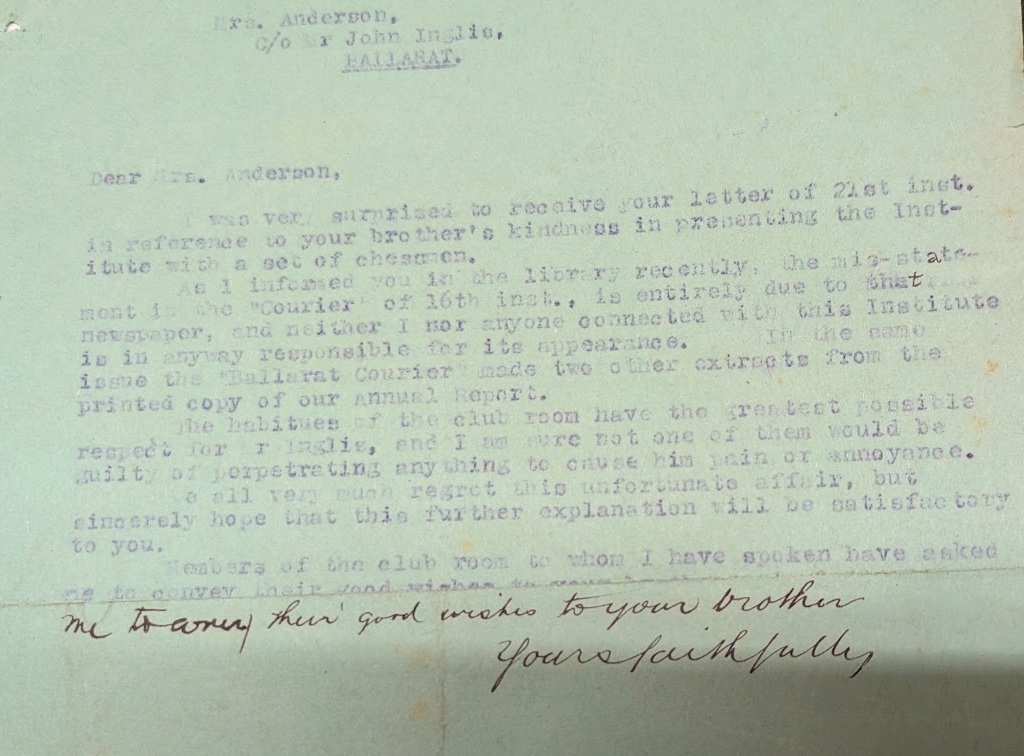
I was very surprised to receive your letter of 21st inst. in reference to your brother's kindness in presenting the Institute with a set of chess men.
As I informed you in the library recently, the mis-statement in the Courier of 16th inst. is entirely due to that newspaper, and neither I nor anyone connected with this Institute is in anyway responsible for its appearance. In the same issue the Ballarat Courier mad two other extracts from the printed copy of our annual Report.
The habitues of the club room have the greatest possible respect for Mr.Inglis, and I am sure not one of them would be guilty of perpetrating anything to cause him pain or annoyance.
We all very much regret this unfortunate affair, but sincerely hope that this further explanation wil be satisfactory to you.
Members of the club room to whom I have spoken have asked me convey their good wishes to your brother.
Yours faithfully

14 August 1943 – The Age (Literary Section)
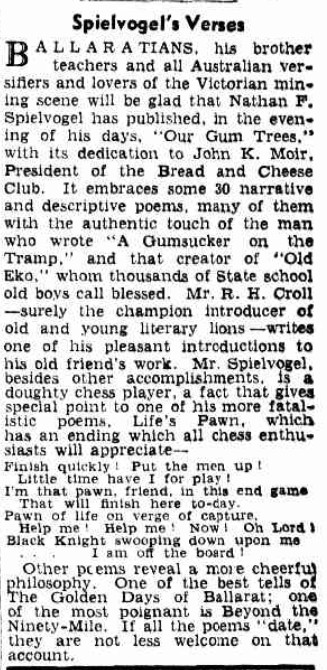
Spielvogel’s Verses
Ballaratians, his brother teachers, and all Australian versifiers and lovers of the Victorian mining scene will be glad that Nathan F. Spielvogel has published, in the evening of his days, Our Gum Trees, with its dedication to John K. Moir, President of the Bread and Cheese Club. It embraces some 30 narrative and descriptive poems, many of them with the authentic touch of the man who wrote A Gumsucker on the Tramp, and that creator of “Old Eko,” whom thousands of State school old boys call blessed.
Mr. R. H. Croll — surely the champion introducer of old and young literary lions — writes one of his pleasant introductions to his old friend’s work. Mr. Spielvogel, besides other accomplishments, is a doughty chess player, a fact that gives special point to one of his more fatalistic poems, Life’s Pawn, which has an ending that all chess enthusiasts will appreciate—
Finish quickly! Put the men up!
Little time have I for play!
I’m that pawn, friend. In this end game
That will finish here to‑day.
Pawn of life on verge of capture,
Help me! Help me! Now! Oh Lord!
Black Knight swooping down upon me
… I am off the board!
Other poems reveal a more cheerful philosophy. One of the best tells of The Golden Days of Ballarat; one of the most poignant is Beyond the Ninety‑Mile. If all the poems “date,” they are not less welcome on that account.


7 March 1946 – Ballarat Mechanics’ Institute
Minutes of the inaugural meeting of the Ballarat Chess Club held at the Mechanics’ Institute, Ballarat.
Mr Spielvogel was elected to be the chair. Mr Spielvogel be elected President. Major Perdue be elected Vice-President. Mr Douglas be elected Secretary-Treasurer.
The President called for a show of hands of those present who were always willing to become members of The Mechanics Institute, explaining that unless this condition were fulfilled, it would be impossible for the person concerned to attend regularly. The vote showed that almost all present were willing.
Mr Glenn suggested that the championship be run in two divisions, the runners-up of the section to play off.
The President suggested that a night be set aside for meetings. After discussion Friday nights were considered most suitable and the members present agreed with the President that the opening night be Friday the 8th of March 1946. Start at 7:30.
Subscriptions were collected from those present: Messrs. N. Spielvogel, Archdeacon Best, Maj. Perdue, A. Best, A.P. Douglas, W.W. Spencer, Hall, L.M. Gunn, Restarick, T.H. Trengrove, F. Donaldson, A. Hyatt, J. Zuinlan (?), T. Hudson, J. Cook, R. Wilson.
Archdeacon Best moved that the Secretary buy a bound minute book. The President and Vice-President addressed the meeting and moved a vote of thanks to Mr Spencer for his enthusiastic work in getting the club formed. Carried with acclamation.
Mr Hall addressed the meeting and recalled previous chess clubs formed in the Institute.
The President adjourned the meeting so that the members could play chess at 8:45 p.m.
14 March 1949 – Ballarat Mechanics’ Institute
At the annual meeting of the Ballarat Chess Club on the 14th of March, 1949, Mr N. Spielvogel was elected President. Mr Purdue said that Mr Spielvogel had held the club together over the years, and he hoped that he would be spared for many years to remain in office. Carried with acclamation.
Mr Glenn suggested that the championship be run in two divisions, the winners of the sections to play off.
15 November 1949 – The Argus
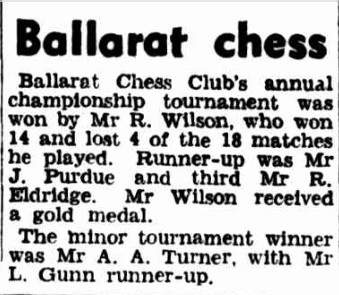
The Ballarat Chess Club’s annual championship tournament was won by Mr R. Wilson, who won 14 and lost 4 of the 18 matches he played. Runner-up was Mr J. Purdue and third Mr R. Eldridge. Mr Wilson received a gold medal.
The minor tournament winner was Mr A. A. Turner, with Mr L. Gunn runner-up.
21 April 1950 – Ballarat Mechanics’ Institute
The 4th annual report of the Ballarat Chess Club.
Once again this year those members who have attended our regular Friday night meetings have enjoyed the friendship and play.
Attendances this year have been slipping from the very high standard set in the past, which is to be regretted. Again this last year we have been fortunate in having the cooperation of the Mechanics’ Institute in making available this room and equipment, and to whom our best thanks are due.
The Major tournament this year was won by Mr Wilson, who beat Messrs. Perdue and Glenn by 5 and 6 points respectively. Mr Turner headed Mr Gunn in the Minor Championship, and the congratulations of the Club are proffered to the winners.
Within the Club, it is a matter for regret that attempts to contact other country clubs with the thought of competition have ended in failure.
21 April 1951 – Ballarat Mechanics’ Institute
The annual meeting of the Ballarat Chess Club.
Mr Perdue moved that Mr Spielvogel be re‑elected with appreciated remarks on the excellent record of Mr President. Mr Glenn seconded and supported these remarks and added that there was likelihood of many good new players joining the club.
Regarding Championships, Mr Perdue suggested that the championship should take a shorter time. Other members seemed to think that the tournament could not be too abbreviated. Mr Cook suggested that because of the credit balance we should obtain a chess clock.
17 April 1953 – Ballarat Mechanics’ Institute
The annual meeting of the Ballarat Chess Club.
The annual meeting was held at the Mechanics Institute on April 17th 1953, when Mr O. Glenn was elected President and L. M. Gunn in his absence was elected Secretary. It was decided to hold a District Championship during the winter months. This commenced in June and extended until the end of the year. An elimination contest was played, leaving 8 players to play off for the Championship and those eliminated played off for a Minor Championship.
The result of the Championship was as follows:
J. Lesins 8.5; A. Shuya 8; R. Wilson 7; J. Melderis 6.5; W. Adams 5; J. Licis 4.5; E. Bauers 2.5;
Aldridge withdrew.
The Minor Championship result was:
O. Glenn 8.5; L. Gunn 7; J. Perdue 6.5.
At the beginning of the season a match was arranged against the Venta (the Melbourne Latvian club; via Teters? ed. BvR) and played at the YMCA on a Saturday afternoon. It resulted in a win for the Ballarat Club. Most members of the Venta Club joined forces with the Ballarat Club and met regularly at the Mechanics Institute.
During the year Mr Arthur Teters joined the club and played in the Australian Open Championship held at Melbourne over the Christmas holidays, and he succeeded in becoming joint holder of the Australian Championship. A very good performance and one which the club wishes to congratulate him on obtaining against strong players.
27 January 1954 – The Weekly Times
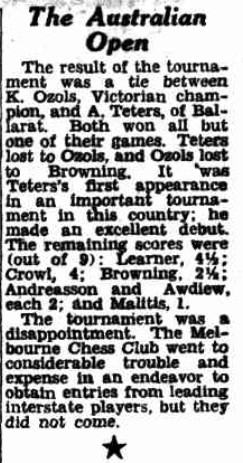
The result of the tournament was a tie between K. Ozols, Victorian champion, and A. Teters, of Ballarat. Both won all but one of their games. Teters lost to Ozols, and Ozols lost to Browning. It was Teters's first appearance in an important tournament In this country; he made an excellent debut. The remaining scores were (out of 9): Learner, 4½; Crowl, 4; Browning, 2½, Andreasson and Awdiew, each 2; and Malitis, 1.
The tournament was a disappointment. The Melbourne Chess Club went to considerable trouble and expense in an endeavor to obtain entries from leading interstate players, but they did not come.